NEWS
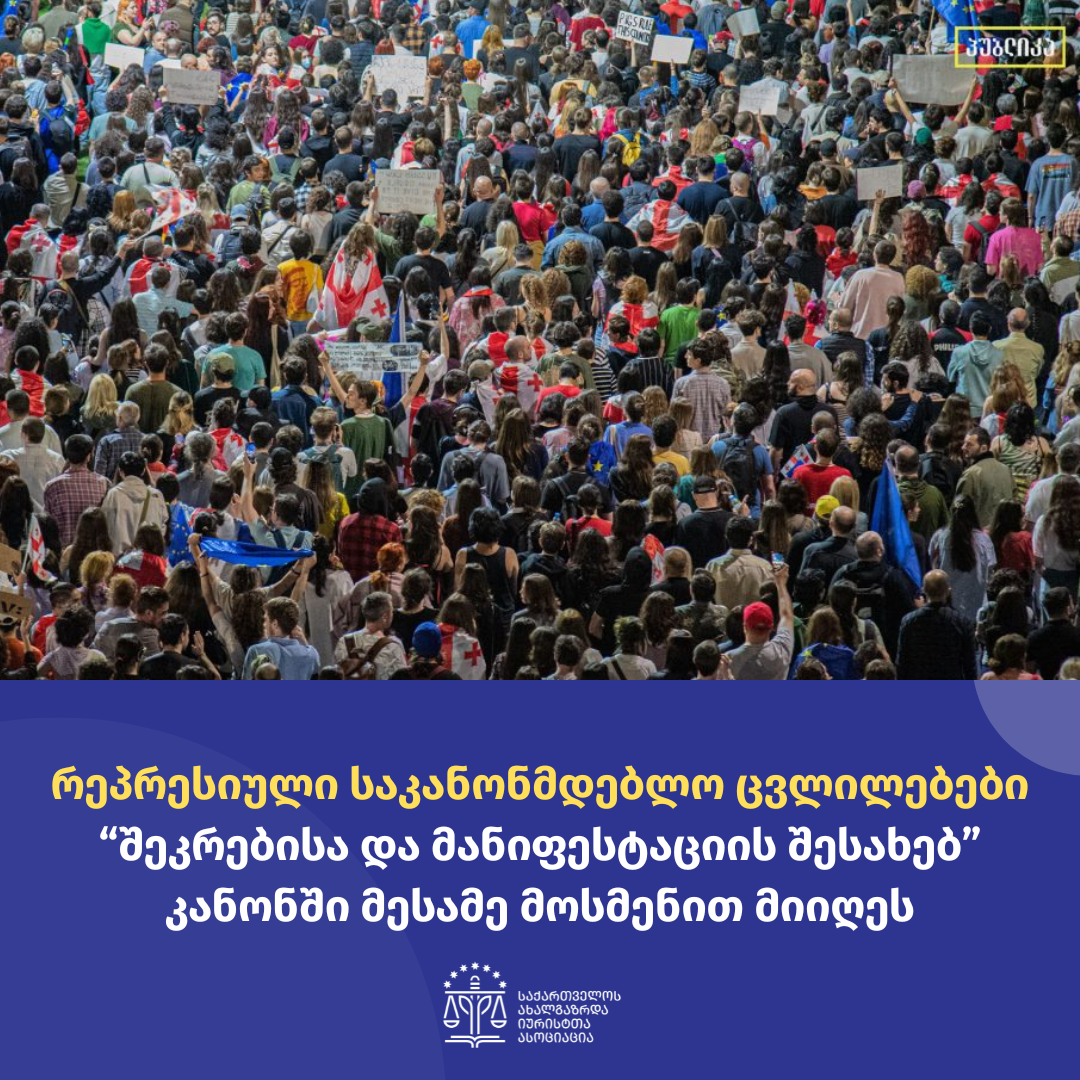
Amid ongoing protests across Georgia, the Georgian Dream party is attempting to suppress the protests by passing repressive laws. The proposed amendments to the Law on Assembly and Manifestation essentially curtail people’s freedom of assembly and expression.1 On February 6, the Georgian Dream parliament passed the amendments in a third reading.
It is worth noting that a number of amendments related to violations of the rules of assembly and demonstration may constitute grounds for an administrative offense. The amendments are also included in this Code, which further weakens the guarantees for the protection of this fundamental right.
The legislative amendments concern the following issues:
1. Responsibility of the organizer of assemblies/manifestations
In the old version, "initiator" refers only to the person who initiates the assembly, and "trustee" refers to a person specifically authorized by this initiator. With the legislative amendment, these terms are abolished and replaced by "organizer" and "responsible person." An "organizer" is now defined as not only the initiator but also any person who "leads and/or otherwise organizes" the assembly. A "responsible person" can be anyone who engages in any organizational activity during the assembly process.
This means that any active participant in the assembly can be held liable, even if they are not officially the organizer. Such vague and broadly interpreted changes may increase the risk of abusive legal prosecution against organizers and activists of assemblies. Additionally, the new wording imposes an obligation on the "responsible person" to submit a signed warning to the municipal executive body regarding the holding of the assembly or demonstration.
Furthermore, within 15 minutes of the warning, the organizer must call on the participants of the assembly or demonstration and take all reasonable actions to open the roadway, restore traffic, and/or dismantle the temporary structure. After receiving the appropriate warning, the owner or legal owner of the temporary structure, or the relevant participant in the assembly or demonstration, must dismantle the temporary structure.
2. Spontaneous gathering/manifestation
The legislation introduces an obligation to notify the administrative body within a reasonable period of time in the event of a spontaneous assembly or demonstration. The Constitutional Court ruled that the requirement for a 5-day prior notice for spontaneous assemblies was unconstitutional, as this condition contradicted the spontaneous nature of the assembly. In the case of a spontaneous rally, the application must be submitted immediately, within a reasonable period of time, after the person responsible for organizing and holding the assembly or demonstration becomes aware of the information about the organization or holding of the spontaneous assembly or demonstration.2 Additionally, the new wording allows representatives of the administrative body to arbitrarily determine the form and procedure for the notification.
GYLA believes that if the notification form is not a simple mechanism, free from technical and bureaucratic barriers, following the amendments to the Code of Administrative Offenses, both the organizers and participants of announced marches may be considered violators of the law simply because no prior notification has been made. Furthermore, the obligation to make this notification makes it clear to the "Georgian Dream" regime who the organizer of a particular march is, which will make it easier for them to launch a repressive mechanism against it. In other respects, information about such marches is public, including for administrative agencies.
3. Holding a gathering or demonstration in a closed space/building without the prior written consent of the owner.
According to the new regulation, it is prohibited to hold a gathering or demonstration in a closed space or building unless the owner gives prior consent, and this consent must be given in writing. In some cases, participants of the rally may not be able to physically obtain the written consent of the owner, even for technical reasons. Additionally, a written document may be the reason for recognizing the owner of the real estate as the organizer of the rally and subsequently imposing liability.
This is a reactionary response to the ongoing protests at universities, which the "Georgian Dream" party wants to prevent with this ban. It is foreseeable that the majority of public universities, especially Tbilisi State University, which is often the main center of such gatherings, will not allow students to gather. The same can be said about Batumi State University, which was one of the centers of protests in the region in 2024.
4. Prohibition of blocking strategic objects
The old version prohibited only the blocking of building entrances, highways, and railways during an assembly or demonstration. However, the list has now been expanded to include the blocking of bridges, tunnels, overpasses, and other transport hubs designated by the municipality. Disruption of these areas would cause significant damage to the normal functioning of enterprises, institutions, and organizations and/or significantly impede traffic movement.
The explanatory note justifies this ban by referencing the European Court of Human Rights case Kudreviš and Others v. Lithuania, where farmers blocked three major highways in the country for more than 48 hours, disrupting economic activities.3 The note states that "the deliberate disruption of road traffic and the usual rhythm of life and the significant disruption of other activities do not constitute an essential part of the freedom of assembly protected by the European Convention." GYLA believes this definition is manipulative, as the European Court's practice acknowledges that any demonstration in a public place can cause some disruption to normal life, including traffic. Additionally, the European Court did not state in this case that such actions should automatically be criminally punishable or that such a rally should automatically be dispersed. It also noted that for 48 hours, the Lithuanian authorities respected the freedom of assembly and did not forcibly disperse the demonstrators.4
As a parallel, the case of Geylan and Others v. Turkey can be cited. This decision was made after the Kudreviš case and is dated 2023. In this case, the European Court of Human Rights found a violation of freedom of assembly and compared it to the standard in the Kudreviš case. In the Turkish case, demonstrators were holding a demonstration on a main road, and the police began to disperse the demonstration immediately, a few minutes after it began and less than 20 minutes after traffic was disrupted. Although the demonstrators had been warned by the police several times beforehand, the European Court found that the disruption to daily life was not of such a magnitude as to justify rapid intervention by the police. 5
According to international human rights standards, including those set out in the Kudrevis case:
- Any demonstration held in a public space may cause a certain level of disruption to the normal rhythm of life, including disruption of traffic;
- The blocking of the road, disruption of normal life and traffic must be analyzed to see whether it is a side effect of the demonstration;
- Law enforcement officers must demonstrate a certain level of tolerance in this regard, which cannot be determined in the abstract and the specific circumstances of the case must be analyzed, especially the extent of the “disruption of the normal rhythm of life” (e.g., to what extent is traffic disrupted, is there a bypass, etc.)
GYLA believes that the “Georgian Dream” will use these changes manipulatively against demonstrators even in cases where it would not have grounds to disperse the rally or file criminal charges in accordance with human rights standards.
5. Restrictions on Holding a Gathering or Demonstration Near a Building
In the old version, the restriction applied only to the area surrounding the administrative building. In the new version, it also applies to the building itself. The 20-meter restriction remains, but now the regulation extends to the building as well.
6. Obstruction of Movement
In the old version, only the obstruction of transport movement was prohibited. The new version also includes the obstruction of people's movement. This change provides the "Georgian Dream" with more opportunities to restrict rallies, as "obstruction of the movement of people" is a vague formulation that can be interpreted broadly.
7. Prohibition on the Erection of Temporary Structures
A new prohibitive regulation on the erection of temporary structures has been added. Specifically, this is prohibited if it creates a threat, hinders police work, harms the functioning of organizations, or is deemed unnecessary for holding a gathering.
This amendment includes many subjective criteria, giving the "Georgian Dream" more leeway to control and restrict rallies. The phrase "not related to holding an assembly" is vague and may serve as a basis for banning any temporary infrastructure. The erection of temporary structures, including tents, is a form of freedom of expression. The use of temporary infrastructure during a protest may fall within the scope of freedom of expression if it remains part of a peaceful protest and does not pose a disproportionate threat to public order.
8. Prohibition of participation in protests terminated at the request of the Ministry of Internal Affairs
Participants of assemblies and demonstrations are prohibited from participating in assemblies that have been terminated at the request of the Ministry of Internal Affairs of Georgia. This will occur if the participants have violated the requirements stipulated by law, such as:
- Possession of firearms, explosives, flammable substances, radioactive substances, cold weapons or pyrotechnic products;
- Possession of a device with laser radiation and/or sharp radiation, the use of which may interfere with the activities of representatives of state agencies and/or the proper functioning of technical means at their disposal;
- Covering the face with a mask or any other means;
- Possession of an object or substance that is used or may be used to harm the life and health of participants of an assembly or demonstration or other persons;
· Containing a lachrymatory, nerve-paralytic and/or poisonous substance.
9. Increasing the Powers of the Ministry of Internal Affairs
Legislative amendments have expanded the powers of the Ministry of Internal Affairs. Previously, this authority belonged to the executive bodies of local governments, namely municipalities. Now, this function is fully transferred to the Ministry of Internal Affairs.
According to the amendments, the Ministry of Internal Affairs:
- Has the right to prohibit the holding of a gathering or demonstration if there is clear evidence, verified by the police, that the gathering or demonstration poses an immediate threat to the constitutional order, the life, or health of citizens.
- Is authorized to prohibit a public gathering and/or demonstration if there is clear evidence, verified by the police, that indicates the gathering and/or demonstration is intended to promote a person’s affiliation with a non-biological sex and/or a gender other than their biological sex, a relationship expressed as a sign of sexual orientation between members of the same biological sex, or incest. For the purposes of this paragraph, the term "promotion" shall be defined in accordance with the Law of Georgia "On Family Values and Protection of Minors."
It is also worth noting that the decision of the Ministry of Internal Affairs of Georgia to prohibit an assembly or demonstration may be appealed to the court, which will make a final decision within two working days.
- In the event of partial or complete blockage of a transport carriageway, it is authorized to decide on opening the carriageway and/or restoring transport traffic.
- To maintain balance, it may impose time and place restrictions.
- In the event of the necessity to block a transport carriageway, it is obliged to ensure safety and determine an alternative transport route.
- It is obliged to maintain a balance between the freedom of assembly or demonstration and the rights of those who live, work, and engage in entrepreneurial activity in the affected areas.
- In the event of a mass violation of requirements, it may demand the immediate cessation of the assembly or demonstration. If the assembly or demonstration does not cease, law enforcement agencies will use measures provided by international law and Georgian legislation to terminate the gathering and disperse its participants.\
It is noteworthy that these amendments, which restrict freedom of assembly, are also being considered in an expedited manner. According to Georgian legislation, the accelerated consideration and adoption of draft laws imply their approval within one week of plenary sessions. However, this is not merely a procedural detail of the lawmaking process. Both the quantitative and substantive aspects of considering legislative initiatives in this manner are essential indicators of the quality of deliberative democracy. In-depth discussion of planned legislative regulations, high public involvement, and the ability of citizens to influence the content of laws directly reflect on their legitimacy and quality. The inappropriate use of exceptional procedures in the lawmaking process significantly harms the rule of law and the principles of legal security.6 The amendments restricting assembly and expression also entered into force in an expedited manner in December 2024.7 https://gyla.ge/post/saia-exmianeba-ivanishvili-distanciur-dakitxvas
GYLA responds to remote questioning of Bidzina Ivanishvili at Giorgi Bachiashvili's trial
Today, another court hearing was held at the Tbilisi City Court on the 1st Criminal Case against Giorgi Bachiashvili.8 At the closed court hearing, Bidzina Ivanishvili, Honorary Chairman of the Georgian Dream party, was questioned as a witness remotely, using technical means, from his own residence.
Based on the prosecution's motion, the court hearing was partially closed to protect commercial secrets. The defense argued that the interrogation protocols of the person known as the victim in the criminal case (Bidzina Ivanishvili) did not contain any commercial secrets. However, Judge Giorgi Gelashvili satisfied the prosecution's motion and partially closed the court hearing.
At the previous court hearing, the prosecution filed a motion requesting the remote interrogation of the witness using technical means. The prosecutor cited Bidzina Ivanishvili's age, the estimated duration of the hearing, and security issues as reasons for the remote questioning. However, the prosecutor did not specify the threats associated with Ivanishvili's appearance at the Tbilisi City Court. Notably, chairmen of various political parties and current and former officials have appeared in court without security concerns. Additionally, Ivanishvili travels with personal security and participates in public gatherings.
It is unclear why such an influential representative of the ruling power, who effectively manages law enforcement agencies, could not feel safe in the court building.
In justifying both motions, the prosecution referred to decisions of the European Court of Human Rights and the regulation of the National Bank of Georgia. The Criminal Procedure Code of Georgia allows for the closure of public hearings to protect commercial secrets and for the remote questioning of witnesses. The prosecution aimed to create a comfortable environment for the victim during questioning by citing age and questioning duration. However, the Georgian Young Lawyers’ Association (GYLA) has monitored criminal hearings for years and has not encountered a similar request for remote questioning based on age and questioning duration.
Given the high public interest, the problematic nature of the criminal offense, and the potential signs of private criminal prosecution, GYLA will continue to monitor the public hearings on Giorgi Bachiashvili's criminal case. https://gyla.ge/post/kidev-uprogamkacrebuli-sisxliskanonmdebloba
Even stricter criminal legislation
The Georgian Dream has introduced amendments to the criminal law, along with other repressive laws. It cites the challenges facing society and the need for a strict approach to them as the basis.9 The accelerated adoption of these amendments is in fact a continuation of the use of criminal law mechanisms as a political tool.
Punishments are being tightened for a number of crimes and aggravating circumstances are being added to them:
1. The proposed changes will intensify the type and severity of punishment for Part 1 of Article 2391 of the Criminal Code, which pertains to public incitement to violent acts. In addition to community service, imprisonment for up to three years will now be possible as a punishment. It is important to note that, following the events of July 5, 2021, the Georgian Dream was not inclined to tighten the punishment for this article. Instead, they were reluctant to even define the offense. This is supported by numerous appeals from GYLA and the 2021 Parliamentary Report of the Public Defender on Human Rights. The report states that "the events of July 5 were preceded by public calls for violence and the mobilization of certain societal groups by leaders of violent groups. Numerous calls for violence were also heard on July 5 itself. Despite the Public Defender
of Georgia presenting a reasoned position to the Prosecutor’s Office of Georgia that the publicly disseminated evidence, at least against two individuals, met the standard for bringing appropriate charges, no investigation was initiated into the facts of public calls for violent actions."10
2. The punishment for Part 1 of Article 353 of the Criminal Code, which involves resistance, threat, or violence against a defender of public order or other government representative, is being tightened. Instead of two to five years of imprisonment, the new punishment is two to six years. Repeated commission of this crime is considered an aggravating circumstance, with a punishment of five to eight years of imprisonment. A crime is considered repeated if preceded by a crime under the same Article (353) or Article 3531. This amendment changes the crime category from less serious to serious.
3. For Article 3531 of the Criminal Code, which pertains to attacks on police officers, employees of the Special Penitentiary Service, or other government representatives, several aggravating circumstances have been added. These include committing the crime in a group, repeatedly, in the presence of a minor, or using explosives, arson, or other generally dangerous means. The legislator has expanded the definition of "generally dangerous means," making it unpredictable.
4. A new crime, Article 3532, has been added to the Criminal Code. This article covers attacks on Georgian state-political officials, political officials, state servants, or public servants. Threatening violence against these individuals carries a penalty of up to three years of imprisonment. If the threat is repeated, made in a group, in the presence of a minor, or involves explosives, arson, or other dangerous means, the penalty is two to six years. Assaulting these individuals carries a sentence of four to seven years, and if aggravating circumstances are present, the sentence is five to twelve years.
5. As a result of the amendments,11 a note was added to Article 222 (Seizure or Blockage of a Broadcasting or Communications Facility or an Object of Strategic or Special Importance) and Article 330 (Seizure or Blockage of an Object of Strategic or Special Importance for Terrorist Purposes) of the Criminal Code. This note specifies that the list of objects of strategic and/or special importance will be determined by a resolution of the Government of Georgia.
It is important to note that one day before a large-scale demonstration planned for February 2, 2025, in Tbilisi, an amendment was made to the Resolution of the Government of Georgia No. 361 of October 23, 2024.12 This amendment determined a list of international and domestic roads for the purposes of Article 222, effectively criminalizing actions related to these roads. Despite the absence of a specific note in Article 222, the Prosecutor's Office of Georgia charged eight individuals detained at the rally near Tbilisi Mall under Articles 19-222 of the Criminal Code, based on the government resolution amendment.13
In parallel with the amendments made to Article 222 of the Criminal Code based on the government resolution, GYLA assessed the danger of using the article for political purposes. GYLA noted that employing criminal law mechanisms against demonstrators is not a legal but a political instrument, which contradicts the principles of a democratic and legal state.14
It is evident that the "Georgian Dream" is instrumentalizing the law, thereby further weakening the guarantees of human rights protection. This includes criminalizing certain actions Amid ongoing protests across Georgia, the Georgian Dream party is attempting to suppress the protests by passing repressive laws. The proposed amendments to the Law on Assembly and Manifestation essentially curtail people’s freedom of assembly and expression.1 On February 6, the Georgian Dream parliament passed the amendments in a third reading.
It is worth noting that a number of amendments related to violations of the rules of assembly and demonstration may constitute grounds for an administrative offense. The amendments are also included in this Code, which further weakens the guarantees for the protection of this fundamental right.
The legislative amendments concern the following issues:
1. Responsibility of the organizer of assemblies/manifestations
In the old version, "initiator" refers only to the person who initiates the assembly, and "trustee" refers to a person specifically authorized by this initiator. With the legislative amendment, these terms are abolished and replaced by "organizer" and "responsible person." An "organizer" is now defined as not only the initiator but also any person who "leads and/or otherwise organizes" the assembly. A "responsible person" can be anyone who engages in any organizational activity during the assembly process.
This means that any active participant in the assembly can be held liable, even if they are not officially the organizer. Such vague and broadly interpreted changes may increase the risk of abusive legal prosecution against organizers and activists of assemblies. Additionally, the new wording imposes an obligation on the "responsible person" to submit a signed warning to the municipal executive body regarding the holding of the assembly or demonstration.
Furthermore, within 15 minutes of the warning, the organizer must call on the participants of the assembly or demonstration and take all reasonable actions to open the roadway, restore traffic, and/or dismantle the temporary structure. After receiving the appropriate warning, the owner or legal owner of the temporary structure, or the relevant participant in the assembly or demonstration, must dismantle the temporary structure.
2. Spontaneous gathering/manifestation
The legislation introduces an obligation to notify the administrative body within a reasonable period of time in the event of a spontaneous assembly or demonstration. The Constitutional Court ruled that the requirement for a 5-day prior notice for spontaneous assemblies was unconstitutional, as this condition contradicted the spontaneous nature of the assembly. In the case of a spontaneous rally, the application must be submitted immediately, within a reasonable period of time, after the person responsible for organizing and holding the assembly or demonstration becomes aware of the information about the organization or holding of the spontaneous assembly or demonstration.2 Additionally, the new wording allows representatives of the administrative body to arbitrarily determine the form and procedure for the notification.
GYLA believes that if the notification form is not a simple mechanism, free from technical and bureaucratic barriers, following the amendments to the Code of Administrative Offenses, both the organizers and participants of announced marches may be considered violators of the law simply because no prior notification has been made. Furthermore, the obligation to make this notification makes it clear to the "Georgian Dream" regime who the organizer of a particular march is, which will make it easier for them to launch a repressive mechanism against it. In other respects, information about such marches is public, including for administrative agencies.
3. Holding a gathering or demonstration in a closed space/building without the prior written consent of the owner.
According to the new regulation, it is prohibited to hold a gathering or demonstration in a closed space or building unless the owner gives prior consent, and this consent must be given in writing. In some cases, participants of the rally may not be able to physically obtain the written consent of the owner, even for technical reasons. Additionally, a written document may be the reason for recognizing the owner of the real estate as the organizer of the rally and subsequently imposing liability.
This is a reactionary response to the ongoing protests at universities, which the "Georgian Dream" party wants to prevent with this ban. It is foreseeable that the majority of public universities, especially Tbilisi State University, which is often the main center of such gatherings, will not allow students to gather. The same can be said about Batumi State University, which was one of the centers of protests in the region in 2024.
4. Prohibition of blocking strategic objects
The old version prohibited only the blocking of building entrances, highways, and railways during an assembly or demonstration. However, the list has now been expanded to include the blocking of bridges, tunnels, overpasses, and other transport hubs designated by the municipality. Disruption of these areas would cause significant damage to the normal functioning of enterprises, institutions, and organizations and/or significantly impede traffic movement.
The explanatory note justifies this ban by referencing the European Court of Human Rights case Kudreviš and Others v. Lithuania, where farmers blocked three major highways in the country for more than 48 hours, disrupting economic activities.3 The note states that "the deliberate disruption of road traffic and the usual rhythm of life and the significant disruption of other activities do not constitute an essential part of the freedom of assembly protected by the European Convention." GYLA believes this definition is manipulative, as the European Court's practice acknowledges that any demonstration in a public place can cause some disruption to normal life, including traffic. Additionally, the European Court did not state in this case that such actions should automatically be criminally punishable or that such a rally should automatically be dispersed. It also noted that for 48 hours, the Lithuanian authorities respected the freedom of assembly and did not forcibly disperse the demonstrators.4
As a parallel, the case of Geylan and Others v. Turkey can be cited. This decision was made after the Kudreviš case and is dated 2023. In this case, the European Court of Human Rights found a violation of freedom of assembly and compared it to the standard in the Kudreviš case. In the Turkish case, demonstrators were holding a demonstration on a main road, and the police began to disperse the demonstration immediately, a few minutes after it began and less than 20 minutes after traffic was disrupted. Although the demonstrators had been warned by the police several times beforehand, the European Court found that the disruption to daily life was not of such a magnitude as to justify rapid intervention by the police. 5
According to international human rights standards, including those set out in the Kudrevis case:
· Any demonstration held in a public space may cause a certain level of disruption to the normal rhythm of life, including disruption of traffic;
· The blocking of the road, disruption of normal life and traffic must be analyzed to see whether it is a side effect of the demonstration;
· Law enforcement officers must demonstrate a certain level of tolerance in this regard, which cannot be determined in the abstract and the specific circumstances of the case must be analyzed, especially the extent of the “disruption of the normal rhythm of life” (e.g., to what extent is traffic disrupted, is there a bypass, etc.)
GYLA believes that the “Georgian Dream” will use these changes manipulatively against demonstrators even in cases where it would not have grounds to disperse the rally or file criminal charges in accordance with human rights standards.
5. Restrictions on Holding a Gathering or Demonstration Near a Building
In the old version, the restriction applied only to the area surrounding the administrative building. In the new version, it also applies to the building itself. The 20-meter restriction remains, but now the regulation extends to the building as well.
6. Obstruction of Movement
In the old version, only the obstruction of transport movement was prohibited. The new version also includes the obstruction of people's movement. This change provides the "Georgian Dream" with more opportunities to restrict rallies, as "obstruction of the movement of people" is a vague formulation that can be interpreted broadly.
7. Prohibition on the Erection of Temporary Structures
A new prohibitive regulation on the erection of temporary structures has been added. Specifically, this is prohibited if it creates a threat, hinders police work, harms the functioning of organizations, or is deemed unnecessary for holding a gathering.
This amendment includes many subjective criteria, giving the "Georgian Dream" more leeway to control and restrict rallies. The phrase "not related to holding an assembly" is vague and may serve as a basis for banning any temporary infrastructure. The erection of temporary structures, including tents, is a form of freedom of expression. The use of temporary infrastructure during a protest may fall within the scope of freedom of expression if it remains part of a peaceful protest and does not pose a disproportionate threat to public order.
8. Prohibition of participation in protests terminated at the request of the Ministry of Internal Affairs
Participants of assemblies and demonstrations are prohibited from participating in assemblies that have been terminated at the request of the Ministry of Internal Affairs of Georgia. This will occur if the participants have violated the requirements stipulated by law, such as:
- Possession of firearms, explosives, flammable substances, radioactive substances, cold weapons or pyrotechnic products;
- Possession of a device with laser radiation and/or sharp radiation, the use of which may interfere with the activities of representatives of state agencies and/or the proper functioning of technical means at their disposal;
- Covering the face with a mask or any other means;
- Possession of an object or substance that is used or may be used to harm the life and health of participants of an assembly or demonstration or other persons;
- Containing a lachrymatory, nerve-paralytic and/or poisonous substance.
9. Increasing the Powers of the Ministry of Internal Affairs
Legislative amendments have expanded the powers of the Ministry of Internal Affairs. Previously, this authority belonged to the executive bodies of local governments, namely municipalities. Now, this function is fully transferred to the Ministry of Internal Affairs.
According to the amendments, the Ministry of Internal Affairs:
- Has the right to prohibit the holding of a gathering or demonstration if there is clear evidence, verified by the police, that the gathering or demonstration poses an immediate threat to the constitutional order, the life, or health of citizens.
- Is authorized to prohibit a public gathering and/or demonstration if there is clear evidence, verified by the police, that indicates the gathering and/or demonstration is intended to promote a person’s affiliation with a non-biological sex and/or a gender other than their biological sex, a relationship expressed as a sign of sexual orientation between members of the same biological sex, or incest. For the purposes of this paragraph, the term "promotion" shall be defined in accordance with the Law of Georgia "On Family Values and Protection of Minors."
It is also worth noting that the decision of the Ministry of Internal Affairs of Georgia to prohibit an assembly or demonstration may be appealed to the court, which will make a final decision within two working days.
- In the event of partial or complete blockage of a transport carriageway, it is authorized to decide on opening the carriageway and/or restoring transport traffic.
- To maintain balance, it may impose time and place restrictions.
- In the event of the necessity to block a transport carriageway, it is obliged to ensure safety and determine an alternative transport route.
- It is obliged to maintain a balance between the freedom of assembly or demonstration and the rights of those who live, work, and engage in entrepreneurial activity in the affected areas.
- In the event of a mass violation of requirements, it may demand the immediate cessation of the assembly or demonstration. If the assembly or demonstration does not cease, law enforcement agencies will use measures provided by international law and Georgian legislation to terminate the gathering and disperse its participants.
It is noteworthy that these amendments, which restrict freedom of assembly, are also being considered in an expedited manner. According to Georgian legislation, the accelerated consideration and adoption of draft laws imply their approval within one week of plenary sessions. However, this is not merely a procedural detail of the lawmaking process. Both the quantitative and substantive aspects of considering legislative initiatives in this manner are essential indicators of the quality of deliberative democracy. In-depth discussion of planned legislative regulations, high public involvement, and the ability of citizens to influence the content of laws directly reflect on their legitimacy and quality. The inappropriate use of exceptional procedures in the lawmaking process significantly harms the rule of law and the principles of legal security.6 The amendments restricting assembly and expression also entered into force in an expedited manner in December 2024.7 https://gyla.ge/post/saia-exmianeba-ivanishvili-distanciur-dakitxvas
GYLA responds to remote questioning of Bidzina Ivanishvili at Giorgi Bachiashvili's trial
Today, another court hearing was held at the Tbilisi City Court on the 1st Criminal Case against Giorgi Bachiashvili.8 At the closed court hearing, Bidzina Ivanishvili, Honorary Chairman of the Georgian Dream party, was questioned as a witness remotely, using technical means, from his own residence.
Based on the prosecution's motion, the court hearing was partially closed to protect commercial secrets. The defense argued that the interrogation protocols of the person known as the victim in the criminal case (Bidzina Ivanishvili) did not contain any commercial secrets. However, Judge Giorgi Gelashvili satisfied the prosecution's motion and partially closed the court hearing.
At the previous court hearing, the prosecution filed a motion requesting the remote interrogation of the witness using technical means. The prosecutor cited Bidzina Ivanishvili's age, the estimated duration of the hearing, and security issues as reasons for the remote questioning. However, the prosecutor did not specify the threats associated with Ivanishvili's appearance at the Tbilisi City Court. Notably, chairmen of various political parties and current and former officials have appeared in court without security concerns. Additionally, Ivanishvili travels with personal security and participates in public gatherings.
It is unclear why such an influential representative of the ruling power, who effectively manages law enforcement agencies, could not feel safe in the court building.
In justifying both motions, the prosecution referred to decisions of the European Court of Human Rights and the regulation of the National Bank of Georgia. The Criminal Procedure Code of Georgia allows for the closure of public hearings to protect commercial secrets and for the remote questioning of witnesses. The prosecution aimed to create a comfortable environment for the victim during questioning by citing age and questioning duration. However, the Georgian Young Lawyers’ Association (GYLA) has monitored criminal hearings for years and has not encountered a similar request for remote questioning based on age and questioning duration.
Given the high public interest, the problematic nature of the criminal offense, and the potential signs of private criminal prosecution, GYLA will continue to monitor the public hearings on Giorgi Bachiashvili's criminal case.
https://gyla.ge/post/kidev-uprogamkacrebuli-sisxliskanonmdebloba
Even stricter criminal legislation
The Georgian Dream has introduced amendments to the criminal law, along with other repressive laws. It cites the challenges facing society and the need for a strict approach to them as the basis.9 The accelerated adoption of these amendments is in fact a continuation of the use of criminal law mechanisms as a political tool.
Punishments are being tightened for a number of crimes and aggravating circumstances are being added to them:
1. The proposed changes will intensify the type and severity of punishment for Part 1 of Article 2391 of the Criminal Code, which pertains to public incitement to violent acts. In addition to community service, imprisonment for up to three years will now be possible as a punishment. It is important to note that, following the events of July 5, 2021, the Georgian Dream was not inclined to tighten the punishment for this article. Instead, they were reluctant to even define the offense. This is supported by numerous appeals from GYLA and the 2021 Parliamentary Report of the Public Defender on Human Rights. The report states that "the events of July 5 were preceded by public calls for violence and the mobilization of certain societal groups by leaders of violent groups. Numerous calls for violence were also heard on July 5 itself. Despite the Public Defender of Georgia presenting a reasoned position to the Prosecutor’s Office of Georgia that the publicly disseminated evidence, at least against two individuals, met the standard for bringing appropriate charges, no investigation was initiated into the facts of public calls for violent actions."10
2. The punishment for Part 1 of Article 353 of the Criminal Code, which involves resistance, threat, or violence against a defender of public order or other government representative, is being tightened. Instead of two to five years of imprisonment, the new punishment is two to six years. Repeated commission of this crime is considered an aggravating circumstance, with a punishment of five to eight years of imprisonment. A crime is considered repeated if preceded by a crime under the same Article (353) or Article 3531. This amendment changes the crime category from less serious to serious.
3. For Article 3531 of the Criminal Code, which pertains to attacks on police officers, employees of the Special Penitentiary Service, or other government representatives, several aggravating circumstances have been added. These include committing the crime in a group, repeatedly, in the presence of a minor, or using explosives, arson, or other generally dangerous means. The legislator has expanded the definition of "generally dangerous means," making it unpredictable.
4. A new crime, Article 3532, has been added to the Criminal Code. This article covers attacks on Georgian state-political officials, political officials, state servants, or public servants. Threatening violence against these individuals carries a penalty of up to three years of imprisonment. If the threat is repeated, made in a group, in the presence of a minor, or involves explosives, arson, or other dangerous means, the penalty is two to six years. Assaulting these individuals carries a sentence of four to seven years, and if aggravating circumstances are present, the sentence is five to twelve years.
5. As a result of the amendments,11 a note was added to Article 222 (Seizure or Blockage of a Broadcasting or Communications Facility or an Object of Strategic or Special Importance) and Article 330 (Seizure or Blockage of an Object of Strategic or Special Importance for Terrorist Purposes) of the Criminal Code. This note specifies that the list of objects of strategic and/or special importance will be determined by a resolution of the Government of Georgia.
It is important to note that one day before a large-scale demonstration planned for February 2, 2025, in Tbilisi, an amendment was made to the Resolution of the Government of Georgia No. 361 of October 23, 2024.12 This amendment determined a list of international and domestic roads for the purposes of Article 222, effectively criminalizing actions related to these roads. Despite the absence of a specific note in Article 222, the Prosecutor's Office of Georgia charged eight individuals detained at the rally near Tbilisi Mall under Articles 19-222 of the Criminal Code, based on the government resolution amendment.13
In parallel with the amendments made to Article 222 of the Criminal Code based on the government resolution, GYLA assessed the danger of using the article for political purposes. GYLA noted that employing criminal law mechanisms against demonstrators is not a legal but a political instrument, which contradicts the principles of a democratic and legal state.14
It is evident that the "Georgian Dream" is instrumentalizing the law, thereby further weakening the guarantees of human rights protection. This includes criminalizing certain actions Amid ongoing protests across Georgia, the Georgian Dream party is attempting to suppress the protests by passing repressive laws. The proposed amendments to the Law on Assembly and Manifestation essentially curtail people’s freedom of assembly and expression.1 On February 6, the Georgian Dream parliament passed the amendments in a third reading.
It is worth noting that a number of amendments related to violations of the rules of assembly and demonstration may constitute grounds for an administrative offense. The amendments are also included in this Code, which further weakens the guarantees for the protection of this fundamental right.
The legislative amendments concern the following issues:
1. Responsibility of the organizer of assemblies/manifestations
In the old version, "initiator" refers only to the person who initiates the assembly, and "trustee" refers to a person specifically authorized by this initiator. With the legislative amendment, these terms are abolished and replaced by "organizer" and "responsible person." An "organizer" is now defined as not only the initiator but also any person who "leads and/or otherwise organizes" the assembly. A "responsible person" can be anyone who engages in any organizational activity during the assembly process.
This means that any active participant in the assembly can be held liable, even if they are not officially the organizer. Such vague and broadly interpreted changes may increase the risk of abusive legal prosecution against organizers and activists of assemblies. Additionally, the new wording imposes an obligation on the "responsible person" to submit a signed warning to the municipal executive body regarding the holding of the assembly or demonstration.
Furthermore, within 15 minutes of the warning, the organizer must call on the participants of the assembly or demonstration and take all reasonable actions to open the roadway, restore traffic, and/or dismantle the temporary structure. After receiving the appropriate warning, the owner or legal owner of the temporary structure, or the relevant participant in the assembly or demonstration, must dismantle the temporary structure.
2. Spontaneous gathering/manifestation
The legislation introduces an obligation to notify the administrative body within a reasonable period of time in the event of a spontaneous assembly or demonstration. The Constitutional Court ruled that the requirement for a 5-day prior notice for spontaneous assemblies was unconstitutional, as this condition contradicted the spontaneous nature of the assembly. In the case of a spontaneous rally, the application must be submitted immediately, within a reasonable period of time, after the person responsible for organizing and holding the assembly or demonstration becomes aware of the information about the organization or holding of the spontaneous assembly or demonstration.2 Additionally, the new wording allows representatives of the administrative body to arbitrarily determine the form and procedure for the notification.
GYLA believes that if the notification form is not a simple mechanism, free from technical and bureaucratic barriers, following the amendments to the Code of Administrative Offenses, both the organizers and participants of announced marches may be considered violators of the law simply because no prior notification has been made. Furthermore, the obligation to make this notification makes it clear to the "Georgian Dream" regime who the organizer of a particular march is, which will make it easier for them to launch a repressive mechanism against it. In other respects, information about such marches is public, including for administrative agencies.
3. Holding a gathering or demonstration in a closed space/building without the prior written consent of the owner.
According to the new regulation, it is prohibited to hold a gathering or demonstration in a closed space or building unless the owner gives prior consent, and this consent must be given in writing. In some cases, participants of the rally may not be able to physically obtain the written consent of the owner, even for technical reasons. Additionally, a written document may be the reason for recognizing the owner of the real estate as the organizer of the rally and subsequently imposing liability.
This is a reactionary response to the ongoing protests at universities, which the "Georgian Dream" party wants to prevent with this ban. It is foreseeable that the majority of public universities, especially Tbilisi State University, which is often the main center of such gatherings, will not allow students to gather. The same can be said about Batumi State University, which was one of the centers of protests in the region in 2024.
4. Prohibition of blocking strategic objects
The old version prohibited only the blocking of building entrances, highways, and railways during an assembly or demonstration. However, the list has now been expanded to include the blocking of bridges, tunnels, overpasses, and other transport hubs designated by the municipality. Disruption of these areas would cause significant damage to the normal functioning of enterprises, institutions, and organizations and/or significantly impede traffic movement.
The explanatory note justifies this ban by referencing the European Court of Human Rights case Kudreviš and Others v. Lithuania, where farmers blocked three major highways in the country for more than 48 hours, disrupting economic activities.3 The note states that "the deliberate disruption of road traffic and the usual rhythm of life and the significant disruption of other activities do not constitute an essential part of the freedom of assembly protected by the European Convention." GYLA believes this definition is manipulative, as the European Court's practice acknowledges that any demonstration in a public place can cause some disruption to normal life, including traffic. Additionally, the European Court did not state in this case that such actions should automatically be criminally punishable or that such a rally should automatically be dispersed. It also noted that for 48 hours, the Lithuanian authorities respected the freedom of assembly and did not forcibly disperse the demonstrators.4
As a parallel, the case of Geylan and Others v. Turkey can be cited. This decision was made after the Kudreviš case and is dated 2023. In this case, the European Court of Human Rights found a violation of freedom of assembly and compared it to the standard in the Kudreviš case. In the Turkish case, demonstrators were holding a demonstration on a main road, and the police began to disperse the demonstration immediately, a few minutes after it began and less than 20 minutes after traffic was disrupted. Although the demonstrators had been warned by the police several times beforehand, the European Court found that the disruption to daily life was not of such a magnitude as to justify rapid intervention by the police. 5
According to international human rights standards, including those set out in the Kudrevis case:
· Any demonstration held in a public space may cause a certain level of disruption to the normal rhythm of life, including disruption of traffic;
· The blocking of the road, disruption of normal life and traffic must be analyzed to see whether it is a side effect of the demonstration;
· Law enforcement officers must demonstrate a certain level of tolerance in this regard, which cannot be determined in the abstract and the specific circumstances of the case must be analyzed, especially the extent of the “disruption of the normal rhythm of life” (e.g., to what extent is traffic disrupted, is there a bypass, etc.)
GYLA believes that the “Georgian Dream” will use these changes manipulatively against demonstrators even in cases where it would not have grounds to disperse the rally or file criminal charges in accordance with human rights standards.
5. Restrictions on Holding a Gathering or Demonstration Near a Building
In the old version, the restriction applied only to the area surrounding the administrative building. In the new version, it also applies to the building itself. The 20-meter restriction remains, but now the regulation extends to the building as well.
6. Obstruction of Movement
In the old version, only the obstruction of transport movement was prohibited. The new version also includes the obstruction of people's movement. This change provides the "Georgian Dream" with more opportunities to restrict rallies, as "obstruction of the movement of people" is a vague formulation that can be interpreted broadly.
7. Prohibition on the Erection of Temporary Structures
A new prohibitive regulation on the erection of temporary structures has been added. Specifically, this is prohibited if it creates a threat, hinders police work, harms the functioning of organizations, or is deemed unnecessary for holding a gathering.
This amendment includes many subjective criteria, giving the "Georgian Dream" more leeway to control and restrict rallies. The phrase "not related to holding an assembly" is vague and may serve as a basis for banning any temporary infrastructure. The erection of temporary structures, including tents, is a form of freedom of expression. The use of temporary infrastructure during a protest may fall within the scope of freedom of expression if it remains part of a peaceful protest and does not pose a disproportionate threat to public order.
8. Prohibition of participation in protests terminated at the request of the Ministry of Internal Affairs
Participants of assemblies and demonstrations are prohibited from participating in assemblies that have been terminated at the request of the Ministry of Internal Affairs of Georgia. This will occur if the participants have violated the requirements stipulated by law, such as:
· Possession of firearms, explosives, flammable substances, radioactive substances, cold weapons or pyrotechnic products;
· Possession of a device with laser radiation and/or sharp radiation, the use of which may interfere with the activities of representatives of state agencies and/or the proper functioning of technical means at their disposal;
· Covering the face with a mask or any other means;
· Possession of an object or substance that is used or may be used to harm the life and health of participants of an assembly or demonstration or other persons;
· Containing a lachrymatory, nerve-paralytic and/or poisonous substance.
9. Increasing the Powers of the Ministry of Internal Affairs
Legislative amendments have expanded the powers of the Ministry of Internal Affairs. Previously, this authority belonged to the executive bodies of local governments, namely municipalities. Now, this function is fully transferred to the Ministry of Internal Affairs.
According to the amendments, the Ministry of Internal Affairs:
- Has the right to prohibit the holding of a gathering or demonstration if there is clear evidence, verified by the police, that the gathering or demonstration poses an immediate threat to the constitutional order, the life, or health of citizens.
- Is authorized to prohibit a public gathering and/or demonstration if there is clear evidence, verified by the police, that indicates the gathering and/or demonstration is intended to promote a person’s affiliation with a non-biological sex and/or a gender other than their biological sex, a relationship expressed as a sign of sexual orientation between members of the same biological sex, or incest. For the purposes of this paragraph, the term "promotion" shall be defined in accordance with the Law of Georgia "On Family Values and Protection of Minors."
It is also worth noting that the decision of the Ministry of Internal Affairs of Georgia to prohibit an assembly or demonstration may be appealed to the court, which will make a final decision within two working days.
- In the event of partial or complete blockage of a transport carriageway, it is authorized to decide on opening the carriageway and/or restoring transport traffic.
- To maintain balance, it may impose time and place restrictions.
- In the event of the necessity to block a transport carriageway, it is obliged to ensure safety and determine an alternative transport route.
- It is obliged to maintain a balance between the freedom of assembly or demonstration and the rights of those who live, work, and engage in entrepreneurial activity in the affected areas.
- In the event of a mass violation of requirements, it may demand the immediate cessation of the assembly or demonstration. If the assembly or demonstration does not cease, law enforcement agencies will use measures provided by international law and Georgian legislation to terminate the gathering and disperse its participants.
It is noteworthy that these amendments, which restrict freedom of assembly, are also being considered in an expedited manner. According to Georgian legislation, the accelerated consideration and adoption of draft laws imply their approval within one week of plenary sessions. However, this is not merely a procedural detail of the lawmaking process. Both the quantitative and substantive aspects of considering legislative initiatives in this manner are essential indicators of the quality of deliberative democracy. In-depth discussion of planned legislative regulations, high public involvement, and the ability of citizens to influence the content of laws directly reflect on their legitimacy and quality. The inappropriate use of exceptional procedures in the lawmaking process significantly harms the rule of law and the principles of legal security.6 The amendments restricting assembly and expression also entered into force in an expedited manner in December 2024.7 https://gyla.ge/post/saia-exmianeba-ivanishvili-distanciur-dakitxvas
GYLA responds to remote questioning of Bidzina Ivanishvili at Giorgi Bachiashvili's trial
Today, another court hearing was held at the Tbilisi City Court on the 1st Criminal Case against Giorgi Bachiashvili.8 At the closed court hearing, Bidzina Ivanishvili, Honorary Chairman of the Georgian Dream party, was questioned as a witness remotely, using technical means, from his own residence.
Based on the prosecution's motion, the court hearing was partially closed to protect commercial secrets. The defense argued that the interrogation protocols of the person known as the victim in the criminal case (Bidzina Ivanishvili) did not contain any commercial secrets. However, Judge Giorgi Gelashvili satisfied the prosecution's motion and partially closed the court hearing.
At the previous court hearing, the prosecution filed a motion requesting the remote interrogation of the witness using technical means. The prosecutor cited Bidzina Ivanishvili's age, the estimated duration of the hearing, and security issues as reasons for the remote questioning. However, the prosecutor did not specify the threats associated with Ivanishvili's appearance at the Tbilisi City Court. Notably, chairmen of various political parties and current and former officials have appeared in court without security concerns. Additionally, Ivanishvili travels with personal security and participates in public gatherings.
It is unclear why such an influential representative of the ruling power, who effectively manages law enforcement agencies, could not feel safe in the court building.
In justifying both motions, the prosecution referred to decisions of the European Court of Human Rights and the regulation of the National Bank of Georgia. The Criminal Procedure Code of Georgia allows for the closure of public hearings to protect commercial secrets and for the remote questioning of witnesses. The prosecution aimed to create a comfortable environment for the victim during questioning by citing age and questioning duration. However, the Georgian Young Lawyers’ Association (GYLA) has monitored criminal hearings for years and has not encountered a similar request for remote questioning based on age and questioning duration.
Given the high public interest, the problematic nature of the criminal offense, and the potential signs of private criminal prosecution, GYLA will continue to monitor the public hearings on Giorgi Bachiashvili's criminal case.
https://gyla.ge/post/kidev-uprogamkacrebuli-sisxliskanonmdebloba
Even stricter criminal legislation
The Georgian Dream has introduced amendments to the criminal law, along with other repressive laws. It cites the challenges facing society and the need for a strict approach to them as the basis.9 The accelerated adoption of these amendments is in fact a continuation of the use of criminal law mechanisms as a political tool.
Punishments are being tightened for a number of crimes and aggravating circumstances are being added to them:
1. The proposed changes will intensify the type and severity of punishment for Part 1 of Article 2391 of the Criminal Code, which pertains to public incitement to violent acts. In addition to community service, imprisonment for up to three years will now be possible as a punishment. It is important to note that, following the events of July 5, 2021, the Georgian Dream was not inclined to tighten the punishment for this article. Instead, they were reluctant to even define the offense. This is supported by numerous appeals from GYLA and the 2021 Parliamentary Report of the Public Defender on Human Rights. The report states that "the events of July 5 were preceded by public calls for violence and the mobilization of certain societal groups by leaders of violent groups. Numerous calls for violence were also heard on July 5 itself. Despite the Public Defender of Georgia presenting a reasoned position to the Prosecutor’s Office of Georgia that the publicly disseminated evidence, at least against two individuals, met the standard for bringing appropriate charges, no investigation was initiated into the facts of public calls for violent actions."10
2. The punishment for Part 1 of Article 353 of the Criminal Code, which involves resistance, threat, or violence against a defender of public order or other government representative, is being tightened. Instead of two to five years of imprisonment, the new punishment is two to six years. Repeated commission of this crime is considered an aggravating circumstance, with a punishment of five to eight years of imprisonment. A crime is considered repeated if preceded by a crime under the same Article (353) or Article 3531. This amendment changes the crime category from less serious to serious.
3. For Article 3531 of the Criminal Code, which pertains to attacks on police officers, employees of the Special Penitentiary Service, or other government representatives, several aggravating circumstances have been added. These include committing the crime in a group, repeatedly, in the presence of a minor, or using explosives, arson, or other generally dangerous means. The legislator has expanded the definition of "generally dangerous means," making it unpredictable.
4. A new crime, Article 3532, has been added to the Criminal Code. This article covers attacks on Georgian state-political officials, political officials, state servants, or public servants. Threatening violence against these individuals carries a penalty of up to three years of imprisonment. If the threat is repeated, made in a group, in the presence of a minor, or involves explosives, arson, or other dangerous means, the penalty is two to six years. Assaulting these individuals carries a sentence of four to seven years, and if aggravating circumstances are present, the sentence is five to twelve years.
5. As a result of the amendments,11 a note was added to Article 222 (Seizure or Blockage of a Broadcasting or Communications Facility or an Object of Strategic or Special Importance) and Article 330 (Seizure or Blockage of an Object of Strategic or Special Importance for Terrorist Purposes) of the Criminal Code. This note specifies that the list of objects of strategic and/or special importance will be determined by a resolution of the Government of Georgia.
It is important to note that one day before a large-scale demonstration planned for February 2, 2025, in Tbilisi, an amendment was made to the Resolution of the Government of Georgia No. 361 of October 23, 2024.12 This amendment determined a list of international and domestic roads for the purposes of Article 222, effectively criminalizing actions related to these roads. Despite the absence of a specific note in Article 222, the Prosecutor's Office of Georgia charged eight individuals detained at the rally near Tbilisi Mall under Articles 19-222 of the Criminal Code, based on the government resolution amendment.13
In parallel with the amendments made to Article 222 of the Criminal Code based on the government resolution, GYLA assessed the danger of using the article for political purposes. GYLA noted that employing criminal law mechanisms against demonstrators is not a legal but a political instrument, which contradicts the principles of a democratic and legal state.14
It is evident that the "Georgian Dream" is instrumentalizing the law, thereby further weakening the guarantees of human rights protection. This includes criminalizing certain actions to intimidate the public and suppress all forms of legitimate citizen protest.15
1 1 Draft Law: On Amendments to the Law of Georgia “On Assemblies and Manifestations”, see: https://info.parliament.ge/#law-drafting/30045 , [05.02.2025].
2 Kudrevičius and Others v. Lithuania [GC], 37553/05, 15.10.2015;
3 Kudrevičius and Others v. Lithuania [GC], 37553/05, 15.10.2015
4 Ibid., paras 176-7;
5 Geylani and Others v. Türkiye, 10443/12, 12.09.2023, §§ 124-126.
6 GYLA, Accelerated Adoption of Laws, 2022, 38.
7 GYLA, What Amendments Will Be Made to the Code of Administrative Offenses to Restrict Freedom of Assembly?, 16.12.2024, https://gyla.ge/post/ra-tsvlilebebi-shedis-administraciul-samartaldargvevata-kodeqsshi, [04.02.2025].
8 The Prosecutor's Office has initiated criminal prosecution against one person for the misappropriation of a large amount of cryptocurrency and legalization of illegal income, Prosecutor's Office website, 06.06.2023, available at: https://pog.gov.ge/news/prokuraturam-didi-odenobiT-kriptovalutis-marTlsawinaRmdego-miTvisebisa-da-ukanono-shemosavlis-legali. Updated:05.02.2025
9 Draft law - "On Amendments to the Criminal Code of Georgia" - https://info.parliament.ge/#law-drafting/30046.
10 Report of the Public Defender of Georgia on the State of Protection of Human Rights and Freedoms in Georgia for 2021, p. 139. Available at: https://www.ombudsman.ge/res/docs/2022040413242699860.pdf, Proposal of the Public Defender of Georgia to initiate criminal prosecution against citizen Spiridon Tskipurishvili for publicly calling for violent action on July 5, 2021, available at: https://ombudsman.ge/res/docs/2021090615354933553.pdf
11 Law of Georgia "On Amendments to the Criminal Code of Georgia", 06.02.2025, available at: https://matsne.gov.ge/ka/document/view/6406169?publication=0#DOCUMENT:1;
12 Resolution No. 28 of the Government of Georgia of January 31, 2025 “On Approval of the List of Objects of Strategic and/or Special Importance” on Amendments to Resolution No. 361 of the Government of Georgia of October 23, 2024, available at: https://matsne.gov.ge/ka/document/view/6402127?publication=0
13 The court granted bail to 8 people detained near Tbilisi Mall, available at: https://publika.ge/tbilisi-moltan-dakavebul-8-pirs-sasamartlom-sapatimro-girao-sheufarda/
14 GYLA calls on the Ministry of Internal Affairs and all authorized persons of the Prosecutor's Office to protect freedom of assembly instead of illegally interfering with it, 02.02.2025, GYLA website, available at: https://gyla.ge/post/GYLA%20-calls-%20to%20-protect-%20freedom%20-of%20-assembly?fbclid=IwY2xjawIWsixleHRuA2FlbQIxMAABHVAHJzDWjEgwVJ2wqLP51GR-92Zq7l3mlizifUvZCSc8sD7lBHs-r2HhdQ_aem_jMro2LwLZyftvmxktxObdQ
15 Georgian Dream declares many aspects of the right to protest illegal - accelerated amendments to the Code of Administrative Offenses, GYLA, 05.02.2025, available at: https://gyla.ge/post/qartuli-ocneba-protestis-uflebis-bevr-aspeqts-zgudavs ; 8 Repressive legislative amendments to the Law “On Assembly and Manifestation” adopted in the third reading, GYLA, 07.02.2025, available at: https://gyla.ge/post/represiuli-sakanonmdeblo-cvlilebebi-saias-shefaseba;
SHARE: