NEWS
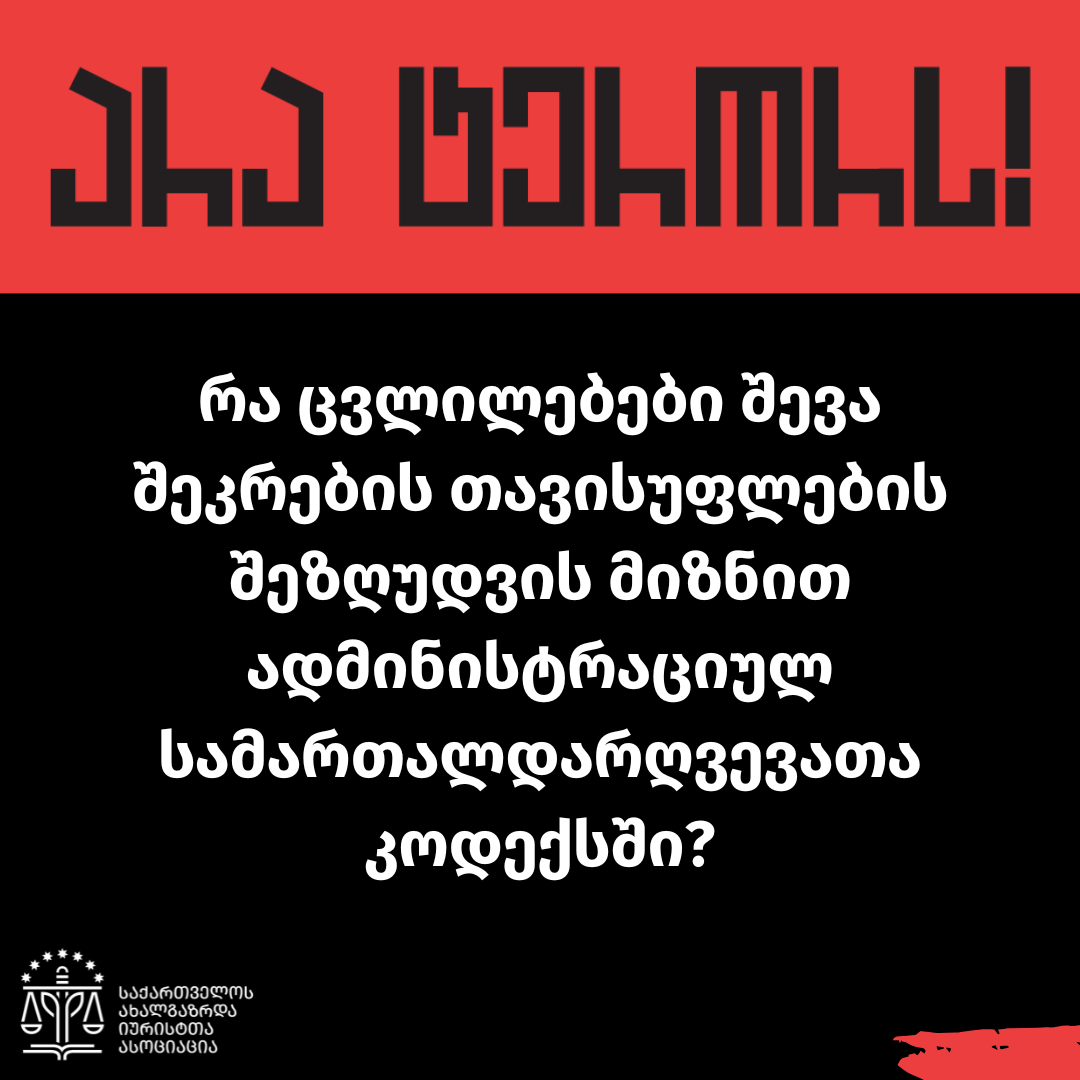
On 13 December 2024, the Parliament approved, in the third reading, a package of legislative amendments aimed at making the Administrative Offences Code[1] an even more repressive tool.
The amendments significantly increase penalties for offences
commonly employed by the Ministry of Internal Affairs against protest
participants. Additionally, new offences
and grounds for arrest have been
introduced into the Code.
It is evident that with the
disproportionate increase in penalties and the introduction of new grounds for
actions related to assemblies, demonstrations and protests, the “Georgian
Dream” attempts to intimidate the public. This is taking place in the context
when the Ministry of Internal Affairs actively employs the Administrative
Offences Code against the participants of the protests, which, by refusing to
uphold the justice, is approved by the judiciary.
Therefore, it is expected that
these penalties will be used not to protect the law and
order, but to suppress the rights to freedom of expression and assembly.
The amendments are, as follows:
1.1.
Covering the face with a mask or any other means will be considered as an administrative offence, punishable by a
fine of 2 000 GEL.
1.2.
Participants of the assembly will also be prohibited
from bringing “devices emitting laser and/or sharp emission, the use
of which could interfere with the operations of state representatives and/or
disrupt the proper functioning of their technical equipment”.
During the ongoing protests, the
MIA is routinely conducting unlawful search and, even confiscating legal items
of individuals, such as gas masks and masks. As a result, it is anticipated that the MIA will use this restriction to justify
illegal searches and apply it disproportionately, including against those individuals possessing laser or
light-emitting devices, who, in reality, with the mentioned items cannot
interfere with the activities of state representatives or the functioning their
technical equipment.
A penalty for violating this
requirement would also be 2 000 GEL.
1.3.
The context of the offence prescribed under Article
173 of the same Code (Non-compliance with a lawful order or demand
of a law-enforcement officer) is incorporated into the provision of
failure of a parent or legal guardian to fulfil their duties regarding a
child’s upbringing, education, or other responsibilities. It is important to
note that police frequently employ Article 173 when arresting demonstrators
without valid grounds.
1.4.
A new offence is introduced to the Code (Article
1983) - illegal wearing
of clothes and equipment of uniform prescribed by the Ministry of Internal
Affairs of Georgia, or the wearing of clothing/equipment resembling the
official uniform and/or equipment prescribed by the Ministry of Internal
Affairs by individuals who are not employees of the Ministry of Internal
Affairs, which, under certain circumstances, may mislead an objective observer.
A penalty for this offence is outlined to be fine in the amount of 2 000 GEL, along with the confiscation of the item.
2.1.
Violating
the rules for organising or holding assemblies or demonstrations
According to the new version of the
Article 1741(4) of the Code, the penalties prescribed for violations
of Articles 9, 11 and 111 of the Law of Georgia “on Assemblies and
Demonstrations” have been significantly increased.
The mentioned provisions are
related to holding assemblies or demonstrations in the prohibited places,
making prohibited calls, having the prohibited items and blocking the traffic
roadway despite the small quantity of the demonstrators.
The former version prescribed fines
in the amount of 500 GEL or administrative arrest for up to 15 days, while in
case an offender was an organizer, fine - in the amount of 5 000 GEL or
administrative arrest for up to 15 days. In the new version, the fines are respectively – 5 000
GEL and 15 000 GEL.
(1) Blocking
a road with vehicles in an organised way or taking part in a group driving in
town or another populated area, during which the roadway is fully occupied
Until now, Article 125(61)
prescribed fine in the amount of 1 000 GEL, while with the new amendments it
also includes the suspension of the
right to drive for 1 year (cumulatively).
2.2.
Defacement
of the appearance of a territory within the administrative boundaries of a
municipality
For the offence
prescribed by Article 150(1), defacement of the appearance of a territory
within the administrative boundaries of a municipality (making various types of
inscriptions, drawings or symbols on building facades, shop windows, fences,
columns, trees or other plantings without authorisation, also putting up
placards, slogans, banners at places not allocated for this purpose, or leaving
fences and buildings unpainted[2]) the fine is increasing and it would be 1 000 GEL instead
of 50 GEL.
The repeated commission
of this offence (Article 150(2)) will carry a
fine of 2 000 GEL instead of 500 GEL.
Similarly, the amount of
fines is increased for other paragraphs of the mentioned Article:
-
Making
various types of inscriptions, drawings, symbols on the facades of
administrative buildings, or in the adjacent territory, including pavement and
road surfaces will carry a fine of 2 000 GEL
instead of 500 GEL. The
repeated commission of this offence will carry a
fine of 3 000 GEL instead of 1 000 GEL, or if the application
of this measure is deemed insufficient after taking into account the
circumstances of the case and the person of the offender - an administrative
arrest of up to 15 days.
-
Defacement
of the appearance of a territory committed in a cultural heritage protection
zone determined under the Law of Georgia “on Cultural Heritage”, will carry a
fine of 2 000 GEL instead of 1 000 GEL. The repeated commission of
this offence will carry a fine of 3 500 GEL
instead of 2 000 GEL.
-
Failure
to remedy the violation defined in this Article within ten days after a fine is
imposed will carry a fine of 1 000 GEL instead
of 500 GEL.
The penalties are
similarly increased for the offences prescribed by Article 1502 (defacement
of the appearance of the Tbilisi city municipality)
-
Arbitrary
making of various types of inscriptions, drawings or symbols on building
facades, shop windows, fences, columns, trees and plants, on pedestrian
walkways and driveways, or putting up of placards, slogans, or banners at
places not allocated for this purpose, or leaving of fences and buildings
unpainted in the Tbilisi city municipality will
carry a fine of 1 000 GEL instead of 200 GEL. The
repeated commission of this offence will carry a
fine of 2 000 GEL instead of 1000 GEL.
-
Arbitrary
making of various types of inscriptions, drawings, or symbols on the facades of
administrative buildings, and in the adjacent territory, including pedestrian
walkways and driveways in the Tbilisi City municipality will carry a fine of 2 000 GEL instead of 1 000 GEL.
The repeated commission of this offence will
carry a fine of 3 000 GEL instead of 2 000 GEL.
-
Commission
of an offence prescribed by this article within a cultural heritage protective
zone determined by the Law of Georgia “on Cultural Heritage”, will carry a fine of 2 000 GEL instead of 1000 GEL.
The repeated commission of this offence will
carry a fine of 3 500 GEL instead of 2000 GEL.
2.3. Vandalism
The fines prescribed for the first and second paragraph of the Vandalism Article (Article 1662) have been increased, and it will be respectively, 1 000 GEL instead of 300 GEL, and 2 000 GEL instead of 500 GEL.
It is also noteworthy that the list of the grounds permitting administrative arrest, personal search, search of belongings and seizure of the belongings and documents, is also expanding. The following new grounds have been added to the existing grounds already prescribed in the Code:
- Preventing delays in the proceedings;
- Preventing a person from avoiding participation in administrative proceedings;
- Preventing the repeated commission of the administrative offence (Article 244).
[1] See, the Draft Law and related files: https://info.parliament.ge/#law-drafting/29789 [11.12.2024].
[2] The normative content of the words in Article 150(1) – ‘also putting up placards, slogans, banners at places not allocated for this purpose’, which excludes the possibility of temporary placement, for a short period of time within a spontaneous protest action, of placards, slogans, or banners by the owner or with the consent of the owner, at places that are not allocated for this purpose - has been declared unconstitutional. – Decision №1/5/1271 of 4 July 2019 of the Constitutional Court of Georgia – website, 09.07.2019
SHARE: