NEWS
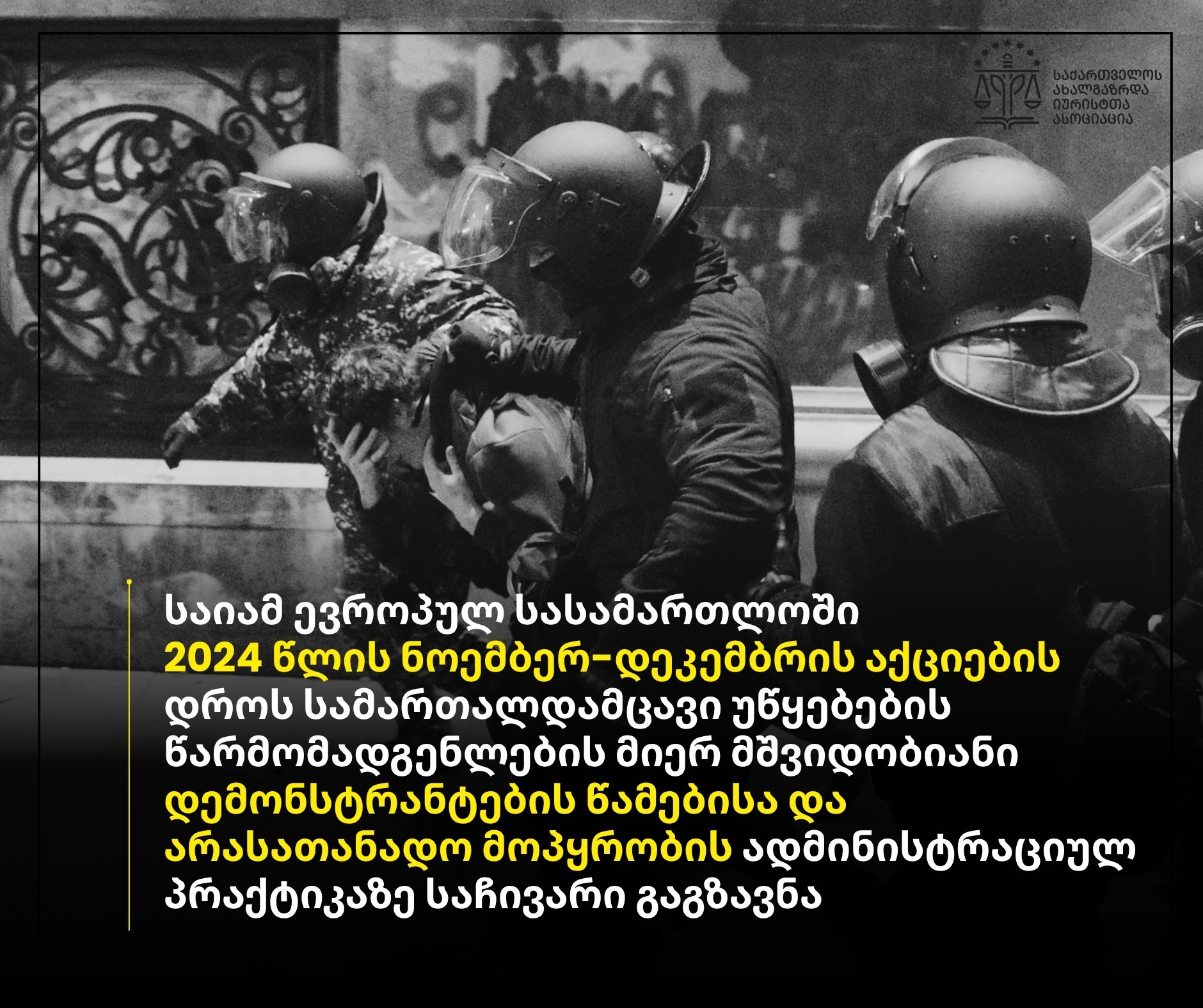
On April 17, 2026, a complaint was filed with the European Court of Human Rights regarding the systematic torture, ill-treatment, and other violations committed by law enforcement officers during the pro-European demonstrations of November–December 2024. The complaint was submitted on behalf of four applicants. In its submission, GYLA argues that the actions taken against them formed part of a coordinated administrative practice of discriminatory ill-treatment targeting protest participants.
Importantly, GYLA contends that the state’s actions amounted not only to violations of individual rights, but also to a gross abuse of power intended to suppress pro-European protests and to go beyond the limits of the democratic order, in breach of Article 17 of the Convention. This line of argument is novel in litigation against Georgia, marking the first time such a complaint is being brought before the Court in the context of demonstrations.
The central strategy of the complaint is to ensure that the Court recognizes and assesses the events surrounding the dispersal of the November–December 2024 rallies. Specifically, GYLA submits that the violence was not the result of isolated misconduct or an improperly conducted dispersal operation, but rather that the dispersal itself constituted organized violence and the starting point of the acute human rights crisis that has unfolded in the country since November 28, 2024. The Court may reach such conclusions by applying Article 17 of the Convention and the other articles invoked in the application.
The evidence confirms deliberate and systematic torture and ill-treatment carried out by masked officers, including:
In parallel with the dispersal of the demonstrations, special forces officers routinely detained and beat protest participants without any lawful basis, often in groups. Detainees were taken beyond the police cordon, out of sight of media cameras, where the violence intensified.
The violence typically continued in specially equipped punishment minibuses, where members of the special forces—using special gloves, their feet, and in some cases batons or other instruments—beat the victims collectively.
The physical violence, both following arrest and inside the minibuses, was accompanied by the seizure of personal items, insults, humiliation, and threats, including threats of sexual assault. As a rule, special forces officers deliberately struck victims on the head and face.
After repeated episodes of beatings in the minibuses, the victims were handed over to patrol or criminal police officers, who transported them to police stations and prepared false arrest reports.
Psychological violence, and in some cases additional physical violence, often continued during transportation and while the victims were held at police stations.
The fact that this was not an individual misconduct but a deliberate state strategy is further confirmed by the public rewarding of the perpetrators by high-ranking officials and the continued impunity of the responsible officers, despite the fact that the issue of command responsibility was explicitly raised by six UN Special Rapporteurs. Impunity is also reinforced by multiple violations observed during the investigative process, including: the abolition of the dedicated investigative body and the transfer of the case to the Prosecutor’s Office; the conduct of the investigation under an incorrect legal qualification; and the creation of artificial obstacles to obtaining evidence, including:
State agencies refuse to hand over surveillance camera footage from buildings around Rustaveli Avenue and the Parliament for investigation, often citing “system malfunction” or “camera damage” (while the recordings from these cameras often become the main evidence in local courts for the often groundless prosecution of demonstrators);
In addition, the Ministry of Internal Affairs confirmed that special equipment was issued without indicating individual numbers.
The involvement of victims in the investigation is limited by the failure to provide copies of the criminal case materials. Only a part of them can be viewed, and only during a visit to the investigative body, based on which we can assess that no effective investigative actions have been carried out since March 2025. Not a single person has been charged to date. Among them, not a single step has been taken to establish the responsibility of state officials.
The appeal is made against Article 3 of the European Convention (prohibition of torture, inhuman or degrading treatment) (substantive and procedural parts); Article 11 (freedom of assembly and association); Article 14 (prohibition of discrimination), in conjunction with the substantive part of Article 3 and Article 11; Article 17 (prohibition of abuse of rights) and Article 1 of Protocol No. 1 (protection of property).
GYLA continues to pursue strategic litigation in the European Court of Human Rights on these and other important cases and will provide the public with relevant updates from time to time. Read more about the details of this case below:
The factual circumstances surrounding the complaint are as follows:
The first applicant was arrested on 2 December 2024 by masked officers of the Special Tasks Department (SDD), who placed him in a specially equipped “punishment minibus” out of public view. There, he was repeatedly and severely beaten with fists, kicks and rubber bullets, eventually losing consciousness. The officers verbally abused him, calling him a “traitor,” and threatened him with sexual assault using brooms, batons and firecrackers, as well as with harm, including sexual assault, against his wife and children. He was later diagnosed with a concussion, a deformed nose, and post-traumatic stress disorder (PTSD).
The second applicant was beaten by SDD officers on 28 November 2024 and then forced through a so-called “police corridor,” where he was struck with special gloves on the head, face, ribs and back, causing extreme pain. In the police minibus, he was beaten again, resulting in a broken nose and heavy bleeding. Despite repeated requests, he was denied transfer to a hospital for more than 16 hours while in the detention centre.
The third applicant was attacked on 29 November 2024 by officers of the special forces unit and beaten on the head, face and shoulder, causing a fractured shoulder blade. He lost consciousness several times. During transport, he was verbally abused and threatened with sexual assault, and his mobile phone was confiscated and never returned.
The fourth applicant was beaten on the head, back and torso by approximately seven masked officers on 30 November 2024 and subjected to homophobic and degrading insults.
GYLA argues that the violations of the Convention arise from the following circumstances:
Violation of Article 3 of the Convention (prohibition of torture and inhuman or degrading treatment):
Substantive violation (in conjunction with Article 14):
Torture (applicants 1, 2 and 3): The prolonged and deliberate severe beatings inflicted on the applicants, including threats of sexual assault and torture in a confined space (minibuses), amount to torture. These acts were intended to punish and intimidate them for their pro-European political views and therefore constituted discriminatory treatment.
Ill-treatment (applicant 4): The unnecessary and disproportionate use of force against the fourth applicant, as well as the homophobic insults, amounted to degrading treatment.
Administrative practice: The applicants’ cases, taken together with other contextual evidence, point to a pre-organized and coordinated system of torture and ill-treatment by law enforcement agencies aimed at suppressing protests.
• Procedural violation (in relation to all four applicants):
Incorrect qualification of the crime: The investigation is being conducted under the wrong article (“Excess of authority” (Article 333 of the Criminal Code)) instead of the relevant provisions — “Torture” (Article 144¹ of the Criminal Code) and “Inhuman treatment” (Article 144³ of the Criminal Code) — which prevents the proper conduct of an effective investigation.
Identification of responsible persons: The investigative bodies have been unable to identify the masked officers. The Ministry of Internal Affairs has confirmed that special equipment was issued without individual identification numbers. The investigation remains inactive, and not a single person has been charged to date. No steps have been taken to establish the responsibility of senior officials.
Obtaining evidence: State agencies refuse to provide CCTV footage from buildings around Rustaveli Avenue and the Parliament, frequently citing “system malfunction” or “camera damage.”
Refusal to provide copies of criminal case files: Despite repeated requests, the Prosecutor’s Office refuses to provide the complainants with copies of the case files, even though they hold victim status and therefore have the right to access these materials.
Delay in investigation: No effective investigative actions have been undertaken in the complainants’ cases since March 2025.
Abolition of the Special Investigation Service: Despite the repeated requests of the Committee of Ministers of the Council of Europe, the abolition of the Special Investigation Service led to the transfer of investigative powers to the Prosecutor’s Office, posing a threat to institutional independence and to the conduct of effective investigations.
Violation of Article 11 (freedom of assembly) of the Convention in conjunction with Article 14:
Unjustified interference: The unlawful detention of the applicants and the use of force against them were not justified, as they were peacefully participating in the demonstration and did not pose a threat. Accordingly, the purpose of this interference was to punish and intimidate them, which does not serve a legitimate aim.
Discriminatory motive: The violation of freedom of assembly occurred on the grounds of political opinion, as part of a coordinated policy of the State to suppress political dissent.
Violation of Article 1 (protection of property) of Protocol No. 1 to the Convention (in respect of the third applicant):
Unlawful seizure of property: The third applicant's mobile phone was unlawfully confiscated.
Lack of effective investigation: The authorities failed to initiate an investigation into this crime, despite the applicant's repeated requests.
Violation of Article 17 of the Convention (prohibition of abuse of rights):
Systematic abuse of power: The actions of the authorities constitute a gross abuse of power aimed at suppressing pro-European protests and go beyond the bounds of a democratic order. This is evidenced by the deliberate torture and ill-treatment carried out by masked officers, the use of minibuses as “punishment sites,” as well as the public rewarding of perpetrators of violence by high-ranking officials and the continued impunity of those responsible.
The dispute under this article is a novelty in terms of litigation, and it can be said that this is the first time a complaint has been brought against Georgia in the context of demonstrations. Article 17 of the Convention, first of all, prevents States Parties from using any of the provisions of the Convention to destroy the rights and freedoms protected therein. Secondly, it prevents States Parties from relying on a provision of the Convention to restrict those rights and freedoms beyond what is permitted under the Convention. In the complaint, we rely on Article 17 to argue that the State acted with the aim of destroying these rights and freedoms or restricting them to a greater extent than is allowed under the Convention.
The joint documentation reports of GYLA and ten other human rights organizations, as well as reports prepared by GYLA, GCRT, members of the UATC coalition, and other organizations, describe in detail—based on testimonies and other evidence—the systematic human rights violations that occurred in November–December 2024, including patterns of torture and ill-treatment. The forms of police violence described in these reports, their intensity, consistency, and scale, demonstrate the widespread and systematic nature of torture and ill-treatment aimed at undermining freedom of assembly and suppressing dissent. This conclusion is further supported by subsequent developments, including ineffective investigations.
For more information, see the independent documentation reports:
1. Human Rights Crisis in Georgia After the 2024 Parliamentary Elections, 2025, available at:, [19.04.2026];
2. Briefing note: Torture and Ill-Treatment During Protests and Suppression of Political Dissent in Georgia in November-December 2024, 2025, [19.04.2026].
1 Article 17 of the European Convention, Prohibition of Abuse of Rights: Nothing in this Convention may be interpreted as implying for any State, group or person any right to engage in any activity or perform any act aimed at the destruction of any of the rights and freedoms set forth herein or at their limitation to a greater extent than is provided for in the Convention itself.
2 GYLA began the process of documenting the ongoing systemic human rights violations, including torture and ill-treatment of demonstrators, in December 2024. 11 Georgian civil society organizations participated in the documentation process.
The documentation was based on both public information and evidence provided by participants in protests and victims of violence, as well as in-depth interviews with them: a semi-structured, in-depth questionnaire was prepared based on a questionnaire developed by international human rights organizations working on torture issues (IRCT, IFEG, Berekely Public health, Omega Research Foundation), taking into account the Georgian context. According to this questionnaire, interviews were conducted with 117 respondents who participated in protests or were subjected to ill-treatment or violence in the context of the ongoing protests from November 19 to January 28; photo-video and medical evidence of ill-treatment of the respondents was collected, focus groups were held with lawyers, and 21 letters were sent to 10 public agencies requesting public information.
SHARE: