NEWS
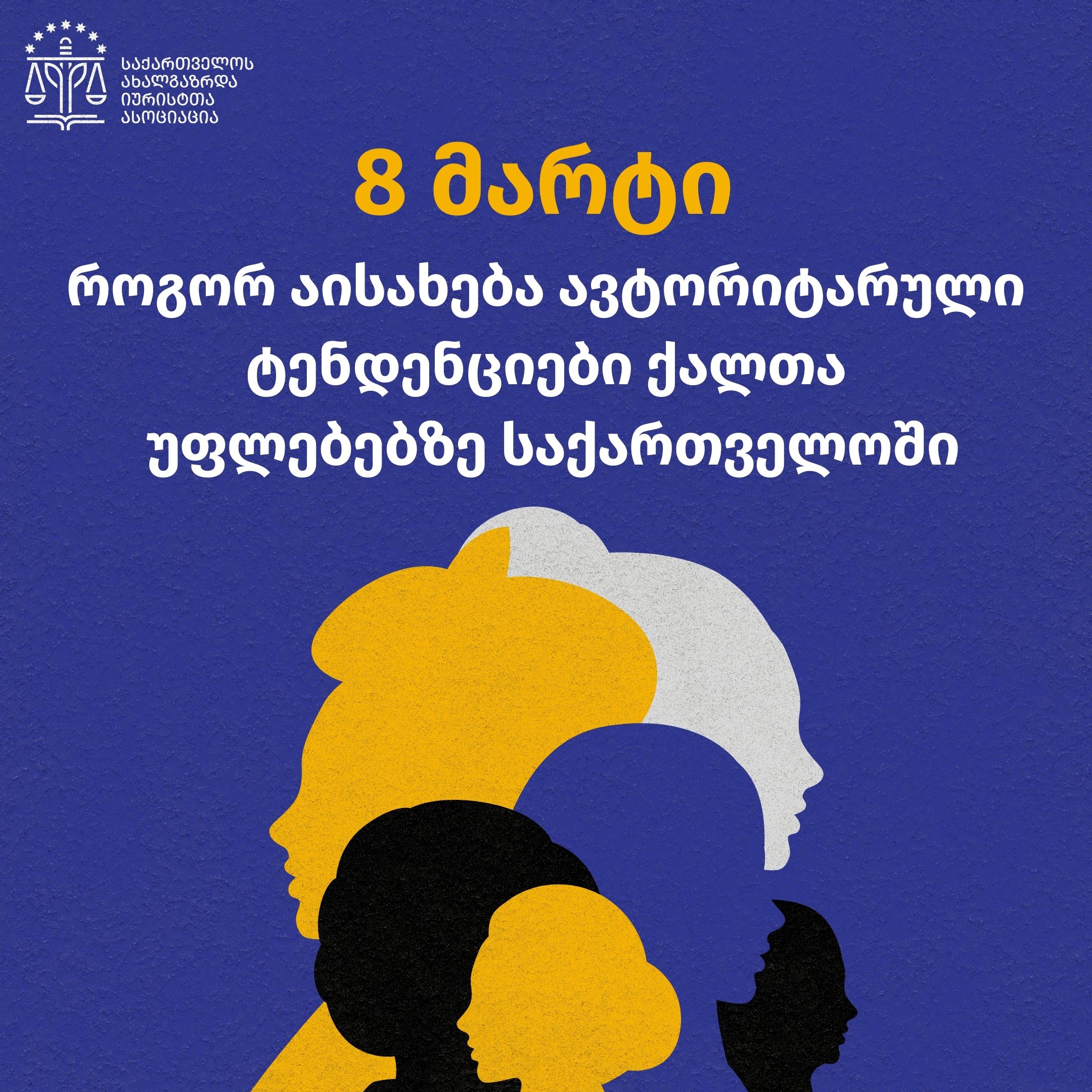
On 8th of March International Women’s Day is celebrated. Ensuring substantive equality between women and men, creating opportunities for the development of women and girls, and combating gender-based and domestic violence are obligations of the state under the Constitution of Georgia and international law.
The rapid consolidation of authoritarianism in Georgia, the shrinking of civic space, and the erosion of human rights significantly harm women’s rights and situation in the country. Instead of addressing the numerous challenges related to gender equality, „Georgian Dream“ itself uses gender stereotypes, disinformation, and insults as tools for consolidating power.
It should be noted that cases of gender-motivated insults and violence used by the police against female participants of protest in 2024-2025 remain without an effective investigation to this day.1 Also, in 2025, a number of individuals arrested under administrative and criminal grounds, including women, stated that following their arrest they were forcibly fully stripped under the pretext of personal search/inspection.2 Such practice contradicts international human rights standards3 and aims to place arrested individuals in a vulnerable, humiliating, and degrading situation that violates their dignity.
When the police, one of the key institutions responsible for the State’s response to gender-based violence, demonstrates sexism and intolerant attitudes toward women, which is encouraged and supported by the state with impunity, it undermines the already fragile trust in state mechanisms on the part of women and victims of domestic violence, and perpetuates a general environment of violence and inequality.
At the same time, anti-gender and discriminatory narratives continue to be actively used to justify authoritarian tendencies. In 2025, Georgian Dream completely removed the term “gender” from the legislation.4 These legislative amendments are based on a false and disinformation-driven narrative alleging that, “through active lobbying by foreign influence and their representatives, there had been a deliberate attempt to introduce the artificial term ‘gender’.” 5 In reality, according to the Istanbul Convention, the term “gender” refers to socially constructed roles, behaviours, activities, or characteristics that a given society considers appropriate for women and men.6 Certain roles or stereotypes contribute to undesirable and harmful practices and to the acceptance of violence against women. According to the Explanatory Report to the Istanbul Convention, violence against women and domestic violence must be understood through a gender perspective, which should form the basis for measures aimed at protecting and supporting victims of violence.7 The disappearance of the concept of gender from legislation is not merely a terminological change. It undermines years of efforts to combat gender-based violence and creates grounds for disregarding the gender perspective of violence and inequality, as well as for ignoring social and cultural factors, which significantly complicates systematic and substantive efforts to address these problems.
Furthermore, the homophobic/transphobic laws adopted by Georgian Dream in September 2024 remain in force. These laws are based on hate-driven narratives and disinformation related to gender identity and sexual orientation and, like several other legislative initiatives, were adopted without democratic participation, without the involvement of experts and other groups of society, and are incompatible with human rights.8
At the same time, a number of issues related to violence against women and domestic violence remain a challenge and constitute an obstacle to achieving substantive equality.
Despite years of advocacy by human rights defenders, Georgian legislation in some cases remains incompatible with the standards of the Istanbul Convention. The most evident example of this is the legislative definition of rape, which, instead of focusing on the absence of consent, still refers to the element of violence.9
Another challenge is the insufficient and ineffective response of law enforcement authorities in cases of violence against women and domestic violence, the lack of comprehensive investigation of gender-motivated crimes, and the insufficient effective protection of victims. Due to the wrong interpretation of the law, there are cases where risk assessment in gender-motivated crimes is refused and where restraining orders are not issued. 10
Problems also persist in the field of violence against women and domestic violence in terms of, on the one hand, the lack of information campaigns for society, and on the other hand, the lack of professional training and capacity-building programmes for relevant professionals.11 For years, coordinated work among different institutions to identify and prevent various forms of violence, including early marriage, has remained problematic.12
In addition, women’s participation in public, political, and economic life remains a challenge. In its Concluding Observations published in February 2026, the UN Committee on Economic, Social and Cultural Rights expressed concern about gender stereotypes and discrimination against women in society, noting that these result in women bearing a disproportionately large and unpaid burden of care and domestic work. This, in turn, hinders their full and equal participation in the labour market and limits their representation in decision-making positions.13 The Committee also expressed concern about the concentration of women in lower-paid employment sectors, which contributes to the gender pay gap.14 The Committee further noted with concern the relatively higher rate of poverty among women.15
Sexual harassment of women in the workplace also remains a widespread problem.16 It is alarming that, according to studies, the majority of cases of sexual harassment remain unreported.17
On the background of the above-discussed challenges, through actions and legislation directed against civil society, “Georgian Dream” further restricts the ability of women and girls to obtain legal assistance and benefit from support services. The elimination of civic space also limits the ability of civil society to raise awareness and advocate for gender equality, portraying such advocacy as “lobbying the ideology of foreign influence.”18 This demonstrates that the consolidation of authoritarian power sacrifices even the insufficient progress that the country had achieved in the protection of women’s rights prior to 2024.
1 Amnesty International, FROM INSULTS TO ASSAULTS: WEAPONIZING GENDER-BASED VIOLENCE AGAINST WOMEN PROTESTORS IN GEORGIA, 2025, https://eurasia.amnesty.org/wp-content/uploads/2025/05/from-insults-to-assaults-police-violence-towards-women-protesters-in-georgia.pdf, Also, GYLA, HUMAN RIGHTS SITUATION IN GEORGIA IN 2025, Assessment of the Georgian Young Lawyers’ Association, December 10, 2025, 35-26.
2 Ibid.
3 According to the European Committee for the Prevention of Torture (CPT), strip searches must not be carried out as an automatic or indiscriminate practice. Such searches must be based on an individual risk assessment and be subject to strict supervision and clearly established standards. Where it is considered necessary to conduct a strip search, the detainee should not be required to remove all clothing at the same time and should be allowed to first remove clothing from the upper body, dress again, and only then remove the remaining clothing. See: CPT/Inf (2025) 11, https://rm.coe.int/1680b4e6af; See also: GYLA, „GYLA responds to the unacceptable practice of stripping detainees”, 29.03.2025, https://www.gyla.ge/post/saia-exmianeba-dakavebulta-gashishvleblis-dausjvebel%20praqtikas.
4 GYLA, HUMAN RIGHTS SITUATION IN GEORGIA IN 2025, Assessment of the Georgian Young Lawyers’ Association, December 10, 2025, 35-26.
5 See the Explanatory Note of the Law https://info.parliament.ge/file/1/BillReviewContent/381678.
6 Council of Europe Convention on preventing and combating violence against women and domestic violence, Article 3-c, https://rm.coe.int/168008482e.
7 Explanatory Report to the Council of Europe Convention on preventing and combating violence against women and domestic violence, par. 43, https://rm.coe.int/ic-and-explanatory-report/16808d24c6.
8 GYLA, The Georgian Young Lawyers’ Association responds to the legislative changes that undermine human rights, democracy, and protections against discrimination, 20.09.2024, https://gyla.ge/post/saqartvelos-akhalgazrda-iuristta-asociacia-diskriminaciul-adamianis-uflebebis-da-demokratiis-tsinaaghmdeg-mimartul-sakanonmdeblo-cvlilebebs-ekhmaureba.
9 GYLA, STATE RESPONSE TO GENDER-BASED VIOLENCE IN GEORGIA LEGISLATION AND PRACTICE ANALYSIS, 2024, 35-36, https://admin.gyla.ge/uploads_script/publications/pdf/genderi_geo.pdf.crdownload.
10 Report of the Public Defender of Georgia On the Situation of Protection of Human Rights and Freedoms in Georgia, 2025, 190-191, https://ombudsman.ge/res/docs/2025040121291438156.pdf.
11 Ibid, 247-248.
12 Ibid, 249-250.
13 E/C.12/GEO/CO/3, para. 25.
14 Ibid.
15 Ibid, para. 39.
16 UN Women, Sexual harassment in the workplace in the private sector of Georgia, 2025, 6, https://georgia.unwomen.org/sites/default/files/2025-06/workplace_sexual_harassment_in_the_private_sector_in_georgia_geo.pdf.
17 Ibid, 7-8.
18 For example, see the explanatory note to the draft law of Georgia “On Gender Equality” on amendments to the Law of Georgia, which was adopted by the Parliament on April 2, 2024: https://info.parliament.ge/file/1/BillReviewContent/381678 .
SHARE: