NEWS
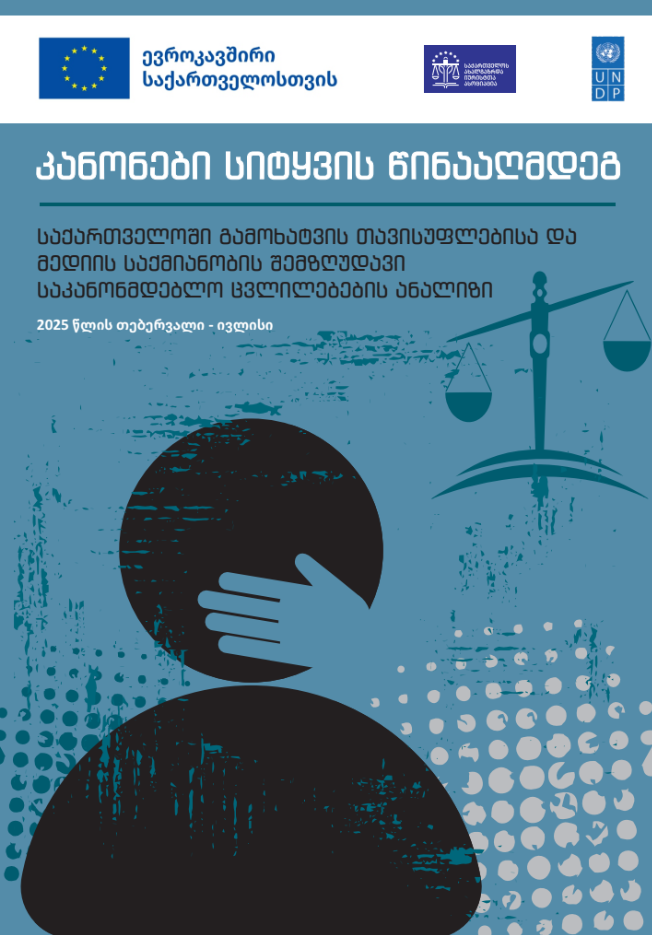
The Georgian Young Lawyers’ Association has published a report ‘Laws Against Speech’. The publication provides an overview of the legislative amendments related to freedom of expression and media activity that have been adopted from the beginning of 2025 until 15 July 2025, covering a period of approximately half a year. The content of each relevant legislative amendment/initiative is assessed in light of international human rights standards and obligations, as well as the prevailing legal and rights-based context in the country.
In 2024-2025, alongside other grave human rights violations such as systemic torture and the violent dispersal of peaceful demonstrations, the Georgian Dream has been particularly active in abusing legislative powers. Since December 2024, the ‘Georgian Dream’ has consistently initiated and adopted in short terms laws that are incompatible with both national and international human rights standards, facilitate the authoritarian consolidation of power, and create new tools for repression.
One of the most evident targets of the legislative amendments has been freedom of expression and activity of media outlets. The deterioration of standards related to the freedom of expression has been pursued through the adoption of the following legislative acts:
Amendments to the Law of Georgia on the ‘Administrative Offences Code of Georgia’;
Amendments to the Law of Georgia on ‘Broadcasting’;
Adoption of a new Law ‘Foreign Agents Registration Act’ (The so-called FARA);
Amendments to the Law of Georgia on ‘Grants’;
Amendments to the Organic Law of Georgia on ‘General Courts’;
Amendments to the Law of Georgia on ‘Freedom of Speech and Expression’.
An analysis of the legislative amendments reveals that they significantly and unjustifiably restrict freedom of expression in various ways and obstacle the media activity, including:
The so-called FARA contains broad and vague provisions that foster self-censorship and enable the arbitrary application of stigmatizing designations, extensive reporting obligations, and other duties and criminal sanctions, including against freedom of expression and media activities.
One of the targets of the legislative amendments is the funding of civil society and the media. Unjustified restrictions on foreign funding are directly or indirectly caused by several legislative acts, including the Law on Broadcasting, the so-called FARA, and the Law on Grants. These restrictions are arbitrary, incompatible with the freedoms of expression and association, and aim to narrow the space for the media and civil society to exist.
The newly introduced and ambiguous regulation of “fairness and impartiality” under the Law on Broadcasting creates a risk of arbitrary sanctions and unjustified content control targeting critical broadcasters.
The new rules regulating photo, video, film recording, broadcast, and audio recording within court buildings, courtrooms, and courtyards effectively prohibit such activities in practice. These provisions disregard the obligation to balance the right to a fair trial, respect for private life, and freedom of expression, and appear aimed at preventing coverage of cases of high public interest.
Amendments concerning defamation under the Law on ‘Freedom of Speech and Expression’ weaken the legal safeguards intended to protect public discourse. These changes make active members of society, including media representatives, more vulnerable to legal proceedings whose real purpose is not to protect the honor and dignity of the complainant, but to suppress the critical expression of the defendant.
The criminalization of insulting public officials and public offers constitutes an interference with freedom of expression and is incompatible with the case law of the European Court of Human Rights. The practical enforcement of Article 173¹⁶ of the Code of Administrative Offenses, coupled with the imposition of high administrative sanctions for permissible forms of expression, demonstrates an intention to create a chilling effect and to foster self-censorship.
See the report in detail at the link
SHARE: