NEWS
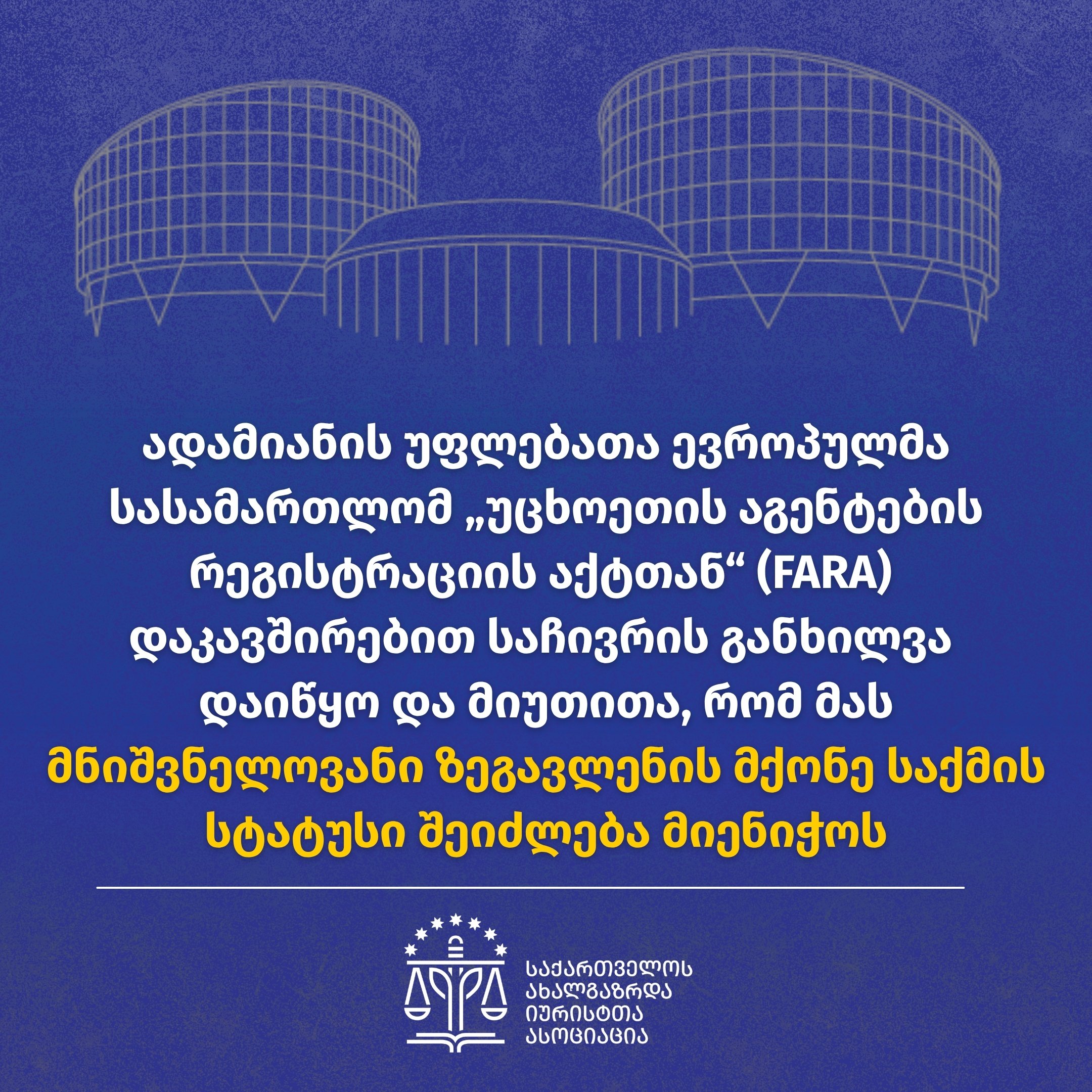
As is known to the public, exactly one year ago, on April 1, 2025, the "Georgian Dream" adopted the "Foreign Agents Registration Act," the so-called FARA, which violates the Constitution of Georgia, Georgia's international treaties in the field of human rights, and aims to silence, discredit, and persecute independent civil society and media, including through the imposition of criminal liability.
According to the communication received from the European Court of Human Rights on March 31, 2026, the Court has begun considering the case related to this law, which GYLA lodged to the Strasbourg Court in 2025 on behalf of 6 applicants, specifically, three organizations (Georgian Young Lawyers’ Association and media organizations: Studio Monitor and Georgian News), and three individuals (heads of the applicant organizations: Nona Kurdovanidze, Nino Zuriashvili, Gela Mtivlishvili).
"Georgian Dream" considers this law to be an analog of the US FARA ("Foreign Agents Registration Act"); however, in reality, the US FARA is a law adopted in 1938 which, considering the historical context and in accordance with the interpretations of the United States Department of Justice and independent courts, aims not to restrict independent civil society and media organizations, but to expose the activities of agents of hostile foreign powers. Furthermore, the aforementioned regulation applies to cases where individuals funded from abroad do not act autonomously and are fully subject to the principal's instructions.
It is important for the Georgian society to know that the real content of legislation is not determined solely by its text, and the direct transposition of legislation operating in other countries cannot ensure its identical functioning. A legal norm that may have the same wording may lead to completely different results in different jurisdictions and at different times, which is conditioned by the structure of the legal system, the political environment, and institutional mechanisms.
In the application, GYLA argues that the "Foreign Agents Registration Act" adopted by Georgian Dream violates the following rights guaranteed by the European Convention on Human Rights: Article 11 (Freedom of assembly and association); Article 10 (Freedom of expression); Article 13 (Right to an effective remedy); Article 14 (Prohibition of discrimination); and Article 18 (Limitation on use of restrictions on rights).
The European Court has accepted the case for proceedings regarding all articles, and the correspondence sent by the Court indicates that the Court may grant the case the status of a significant "impact case." This means that the Strasbourg Court will consider the case in a priority regime, as it concerns a legal problem of fundamental importance, and the decision reached in this case will become a precedent not only for Georgia but for all member countries of the Council of Europe.
The application substantiates that, alongside vague norms, the executive subjects of the law (in the past the Anti Corruption Bureau - now its legal successor, the Audit Office, the Prosecutor's Office, Domestic Court) are granted unbalanced powers, which increases the risks of arbitrary application of the law.
Additionally, there is a significant chilling effect that the relevant subjects may experience in expectation of this type of enforcement.
Regarding the procedure, we clarify that by starting the consideration of the case on the merits, the European Court has posed questions to which the State will first have to respond. It is particularly noteworthy that the Court pointed out the need to assess whether the State used the restriction of rights covertly for other, non-conventional purposes. Specifically, whether the real and dominant purpose of restricting rights was another hidden intention, such as political retribution and/or silencing critical voices, which is inherently incompatible with the Convention.
Questions:
· Victim Status - Can the applicants claim "victim" status due to the operation of the law (Article 34 of the Convention)? Specifically, have any provisions of the law been applied to them?
· Respect for Private Life - Does the obligation to submit personal data and labeling established by the law constitute an interference with the rights of the individuals (applicants)? In the case of an affirmative answer, was this interference compatible with the requirements established by the second paragraph of Article 8 of the Convention?
· Freedom of Expression and Association - Did the operation of the law (including: obligations of registration, reporting, disclosure, labeling, and record-keeping) violate the rights of the applicants (Articles 10 and 11 of the Convention)? In the case of an affirmative answer, was this interference compatible with the requirements set out in the second paragraphs of these articles of the Convention?
· Stigmatization - Does referring to organizations as an "agent of a foreign principal" have a stigmatizing effect, considering the specific linguistic nuances of the Georgian language? Does this term have a significant deterrent impact on the activities of the organizations? What objective evidence (such as public opinion polls, opinions of linguistic experts) exists to substantiate that this designation carries a stigmatized connotation in the Georgian language?
· "Foreign Power" and "Agency Relationship" - Does the definition of a "foreign principal" correspond to the principles of necessity, relevance, and sufficient substantiation? Does the law define with sufficient clarity the "agency relationship" between a "foreign power" and a national "agent" to avoid broad and potentially abusive interpretations?
· Proportionality of Sanctions - Are the sanctions imposed for violations of the law proportionate to the gravity of the committed actions?
· Discrimination - Does the operation of the law constitute discriminatory treatment toward the applicants (Article 14 of the Convention in conjunction with Articles 8, 10, and 11)?
· Effective Legal Remedy - Did the applicants have access to effective domestic legal remedies to protect their rights (Article 13 of the Convention)?
· Restriction of Rights with Ulterior Motive - Did the State use the restriction of rights provided by Articles 8, 10, and 11 of the Convention for purposes other than those provided by these articles themselves (Article 18 of the Convention)?
The State has been set a deadline of July 21, 2026, by the Court to present its position, after which, according to the procedure, the applicant party will present a responsive written communication.
We also remind the public that the European Court of Human Rights has already, effectively, concluded the consideration of the joint application of 136 organizations and 4 individuals regarding the so-called "Russian Law" (on Transparency of Foreign Influence) (see: Georgian Young Lawyers’ Association and Others v. Georgia, no. 31069/24).
GYLA, as the representative of the applicants, will provide updated information to the public from time to time.
SHARE: