NEWS
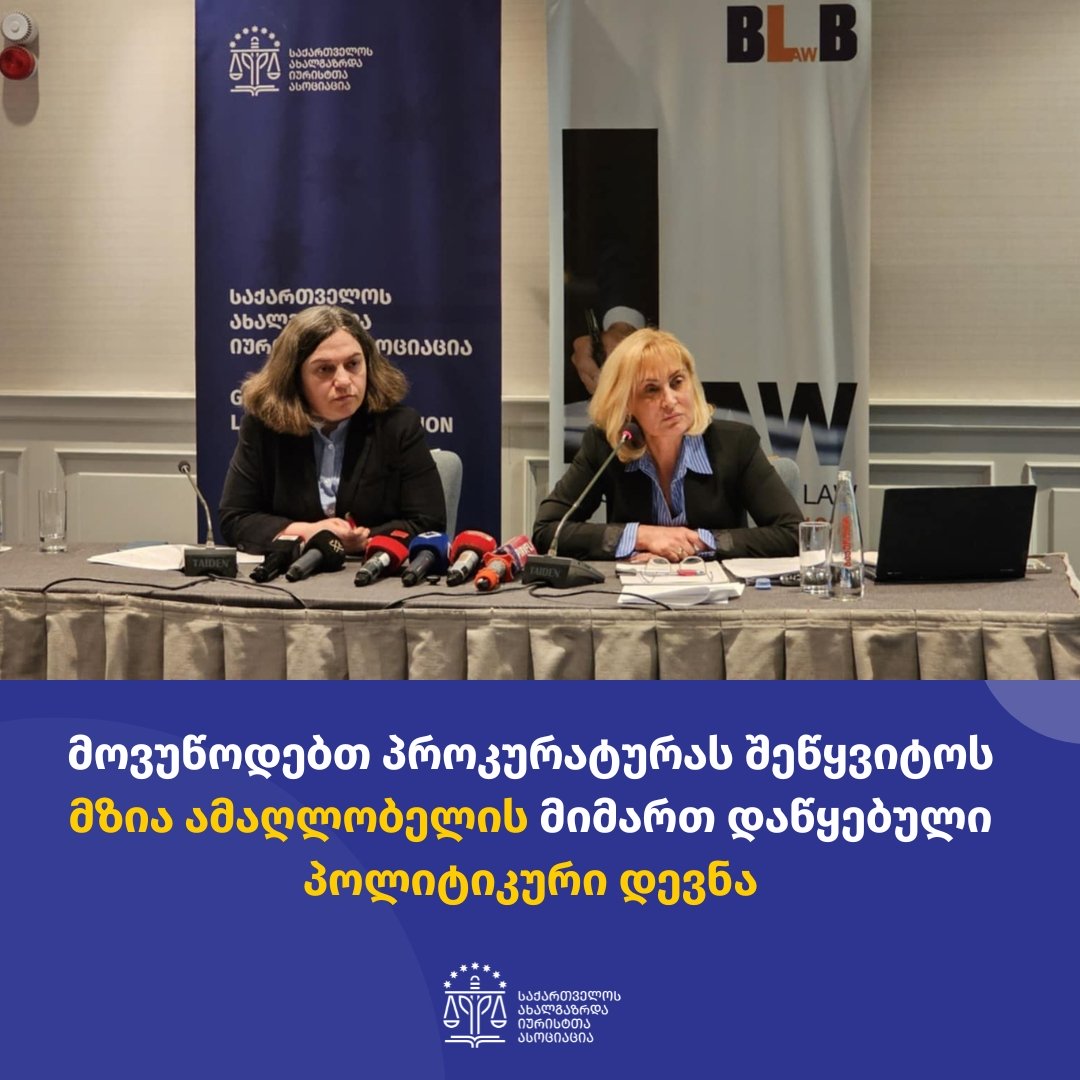
The lawyers of Mzia Amaglobeli, the founder of “Batumelebi” and “Netgazeti”, are filing a motion to request the annulment of the detention as a measure of restraint against her. As it is known to the public, the Prosecutor’s Office has initiated the criminal prosecution against Mzia Amaglobeli without grounds, charges imposed on her are unlawful and the most severe form of a measure of restraint - detention - has been unlawfully applied to her.
On 11 January 2025, prior to the detention of Mzia Amaglobeli under criminal charges, she was arrested administratively, while putting up a protest sticker. Unlawfully detained Mzia Amaglobeli was later released on a personal guarantee, however, shortly, she was detained under criminal law, charged with Article 3531(1) of the Criminal Code of Georgia, which pertains to attacking a police officer in connection with their official activities.
We present the joint assessment of Mzia Amaglobeli’s lawyers:
The Absence of Grounds for Applying a Measure of Restraint and the Legal Prerequisites for its Change
What the Grounds for Applying a Measure of Restraint Were
On 14 January 2025, the first appearance hearing took place in the Batumi City Court. The prosecutor unjustifiable requested to impose the most severe form of a measure of restraint – detention. The prosecutor’s unsubstantiated motion was granted by Judge Nino Sakhelashvili. The court’s decision was based on the prosecution’s abstract and hypothetical position regarding the assumption of the commission of a new crime and the destruction of evidence. The motion of the Prosecutor’s Office did not present any arguments or circumstances, and even evidence, that would substantiate the existence of these risks to the minimum standard. On the one hand, the Prosecutor’s Office and, on the other hand, the court did not consider the requirement of the Criminal Procedure Code of Georgia, which prescribes that detention shall be applied only in exceptional cases and the priority shall be given to other measures of restraint.
Although there had not been any grounds for the application of a measure of restraint, the lawyers of Mzia Amaglobeli still proposed a less severe alternative measure than detention – bail. Nevertheless, the judge unconditionally granted the prosecutor’s motion. The court used the fact of Mzia Amaglobeli’s administrative detention and the possible commission of an offence against her, even though the lawfulness of the detention had not been determined, nor had the fact of the alleged offence been established. In doing so, the judge violated Mzia Amaglobeli’s right to liberty and the presumption of innocence and demonstrated clear bias in favour of the prosecution.
Legal Grounds for the Annulment of a Measure of Restraint
The defence applies to the court to annul the measure of restraint/detention imposed on Mzia Amaglobeli, as the detention does not serve a legitimate aim.
According to the standard established by the Strasbourg Court, the detention should cease as soon as the risk that has been a ground for its application has passed, which requires constant monitoring. Therefore, as established by the Strasbourg Court, the grounds for detention must be justified at every stage of its application and for each day of detention. Continuous monitoring must be ensured, along with an effective mechanism for review at every stage.
On 14 January 2025, the Batumi City Court justified the detention of Mzia Amaglobeli on two grounds, that (a) there was a risk to exert pressure on witnesses, and (b) there was a risk of committing a new crime.
The defence’s motion outlines new substantive circumstances and presents evidence based on which the detention applied to Mzia Amaglobeli should be annulled.
(a) According to the criminal case files provided to the defence, the investigation is practically complete, and only police officers (6 police officers) have been questioned as witnesses, with no other individuals or participants of the protests, as the prosecution suggested when justifying the motion for the application of a detention, have been questioned. It is clear that the request for Mzia Amaglobeli’s detention, based on the potential risk of exerting pressure on witnesses, was completely unjustified and unreasonable, and did not meet any standards. This risk is even more absurd at this stage of the investigation, when the Prosecution has to rejustify what the current risk of exerting pressure on witness is and why Mzia Amaglobeli’s detention is the only measure to prevent this risk, when all the witnesses are police officers and have already been questioned. Additionally, as new circumstances, we have presented the protocol of Mzia Amaglobeli’s questioning to the court. Hence, at this stage of the investigation, all witnesses (those deemed necessary by the investigation), the victim, and the accused have been questioned.
(b) In the ruling of 14 January 2025, in order to justify the detention, the judge relied on the administrative detention report of Mzia Amaglobeli, according to which she was detained administratively under Article 173 of the Administrative Offences Code, which is not correct.
We will present a video file to the court, where it is clearly visible that Mzia Amaglobeli was detained by the Head of the Adjara Police Department (Grigol Beselia) for placing a sticker on a police fence, not for insulting the police. Mzia Amaglobeli was detained for an action that does not constitute an offence under the Georgian law. The Administrative Offence Report itself also falsely identifies the person who detained Mzia Amaglobeli as Gocha Vazadze, the Deputy Head of Batumi City Police Department.
Despite the fact that one month has passed since Mzia Amaglobeli’s administrative detention, she has not been handed over the Administrative Offence Report, and no administrative offence case has been heard at the court. Therefore, there is no ruling regarding the commission of a non-existent administrative offence by Mzia Amaglobeli. As for the administrative detention report itself (on which the court’s unlawful ruling was based), it has been appealed by Mzia Amaglobeli, however, as for now, it has not been considered by the relevant department of the Ministry of Internal Affairs.
A suspicion arising during the assessment of evidence shall be resolved in favour of the accused by the judge. The video file we present clearly shows that the detention report for Mzia Amaglobeli is a forged document and that her detention was unlawful, as she did not commit an administrative offence. Therefore, considering the new substantive circumstances, there is no longer a minimum justification for the “risk of committing a new crime,” which was based solely on one document in the criminal case file - the forged administrative detention report.
(For further details on Mzia Amaglobeli’s unlawful administrative detention, please, refer to Chapter 4 of the Statement).
The Disputed Professional Qualification of the Judge
The first appearance court hearing in Batumi City Court, which resulted in the decision to apply detention on Mzia Amaglobeli, was conducted by Judge Nino Sakhelashvili. According to information available on the website of the High Council of Justice, she passed the judicial qualification exams in the field of civil-administrative law. In 2022, she began her judicial career in the Chamber of Civil Cases of Batumi City Court. However, the same website does not indicate when she changed the Chamber and since when she has been hearing criminal cases. If the High Council of Justice reallocated her to another chamber, this confirms a problematic practice whereby judges are assigned to chambers without consideration the area in which they passed their qualification exams. Thus, the decision to impose detention on Mzia Amaglobeli was decided by a judge who does not have the qualification in criminal law. This practice could potentially also be assessed as a violation of the right to a fair trial.
The Unlawful Criminal Charge
The Prosecutor’s Office charged Mzia Amaglobeli under Article 3531(1) of the Criminal Code. The mentioned Article prescribes an attack on police officer, or his/her official or residential building, or his/her vehicle, or his/her family member in connection with the official activities of the police officer. For the act to be classified under this article, the following key elements must be present:
Assault - as a particularly violent, aggressive act, accompanied by violence or the threat of violence;
The assault must be directed against the life, health, or property of a police officer or their family members and the assault should involve such a threat;
The assault must be carried out with direct intent;
The assault must be related to the police officer’s specific official activities, or due to conducting official activities, and there must be some kind of link/connection between the perpetrator and the victim’s official activities.
The action of Mzia Amaglobeli – the extended left-hand that hits Irakli Dgebuadze’s face - does not include any of these elements. As Irakli Dgebuadze himself describes, as a result of Mzia Amaglobeli’s slapping, redness appeared on his right cheek and right ear, and he experienced pain during the incident. According to court’s case-law, physical pain confirmed only by subjective perception does not fall under the definition of assault prescribed by Article 3531. The incrimination of the action cannot be based on the victim’s subjective perceptions. Furthermore, Mzia Amaglobeli’s action cannot be assessed as any kind of violence that would allow her conduct to be classified under any other article of the Criminal Code. Therefore, Mzia Amaglobeli’s criminal prosecution takes on the character of personal punishment, intimidation, and political repression.
Conflict of Interest in the Course of Investigation of Mzia Amaglobeli’s Case
An investigator shall be obliged to conduct an investigation thoroughly, fully and impartially, which, in this case, is completely disregarded, as there is a clear conflict of interest.
The person granted a victim status in the case is Irakli Dgebuadze, the Head of the Batumi City Police Department, who has been the head of Batumi police for the past few years. For about a month, the investigation was conducted by the investigative unit located in the same administrative building (where the victim is working). The main witnesses for the prosecution in the case are police officers from the same department. The Head of the Investigative Unit (Berdia Peradze), whose subordinates were also conducting the investigation, is one of the key witnesses for the prosecution and, in addition, he was the one who detained Mzia Amaglobeli. Overall, both the investigators and the witnesses, including the victim, are under the authority of Grigol Beselia, the Director of the Adjara Police Department, who unlawfully detained Mzia Amaglobeli under administrative basis. It has been repeatedly reported in the media that Grigol Beselia is a godfather of Irakli Dgebuadze.
Since the commencement of the investigation, Mzia Amaglobeli’s case had been investigated by the Investigative Service of the Adjara Police Department. The defence requested the General Prosecutor to remove the criminal case from the Adjara Police Investigative Service and assign it to the Investigative Unit of the General Prosecutor’s Office. If this request were granted, the case would be also transferred away from the Adjara Prosecutor’s Office.
The defence was verbally informed that a few days ago the General Prosecutor’s Office had assigned the case to the Guria Police Department. However, this does not eliminate the conflict of interest and does not create even a basic sense of objectivity, as the Adjara Prosecutor’s Office again conducts prosecutorial supervision of the Guria Police Department, and the Adjara Prosecutor’s Office supervised the case of Mzia Amaglobeli since the first day of the investigation. The Adjara Prosecutor’s Office has demonstrated that it lacks the ability to consider the criminal responsibility of Grigol Beselia and other police officers for the unlawful administrative detention of Mzia Amaglobeli and the falsification of documents related to the administrative case against her. In addition, there is no doubt that the Adjara Prosecutor’s Office maintains daily professional and operational connections with both the Adjara Police Department and the head of Batumi Police, as well as all its divisions.
Arbitrary Administrative Detention
On 11 January 2025, activists gathered in Batumi for a protest, displaying stickers with the inscription: “Georgia goes on strike on 15 January at 15:00”. During the protest, the police began arbitrarily detaining participants. Upon learning that her friend and colleague, Tsiala Khatamidze, had been detained, Mzia Amaglobeli arrived at the scene and took a sticker from one of the individuals and was placing it on the wall. At this moment, due to placing a sticker, she was detained under administrative law. Approximately one hour after her detention, Mzia Amaglobeli was released on a personal guarantee. There are video footage in the public sources showing the administrative detention of Mzia Amaglobeli, where it can be seen that the head of the Adjara Police, Grigol Beselia, personally detains her as soon as she places the sticker, and Mzia Amaglobeli complies with the unlawful detention without any resistance or verbal comment.
The Administrative Offences Code prescribes the grounds on which a police officer is authorized to detain a person. The temporary placement of a sticker on the building’s fence cannot be considered as defacement of its appearance; in addition, temporary placement of a sticker on the administrative buildings is not prohibited by this Code. Even if this action were to be considered as defacement of the appearance or painting, the employee of the MIA does not have the authority to detain a person for such an action, according to the law. To cover up Mzia Amaglobeli’s arbitrary and unlawful detention, the police drew up a detention report under Article 173 of the Administrative Offences Code, which was not presented to Mzia at the time of her detention. The detention report contains false information, claiming that Mzia Amaglobeli insulted and abused the police prior to her detention, which is a complete lie. This falsehood is confirmed by the video footage of Mzia Amaglobeli’s detention. Additionally, as of now, no Administrative Offence Report has been compiled, nor has the court established the fact of any offence. Despite this, both the Prosecutor’s Office and the Batumi City Court used this circumstance and the false administrative detention report to justify Mzia Amaglobeli’s detention under criminal charges.
On 21 January 2025, the administrative detention report was appealed to the Ministry of Internal Affairs on behalf of Mzia Amaglobeli, but as of now, no decision has been made regarding the complaint.
Ill-treatment of Mzia Amaglobeli
Following the criminal detention, Mzia Amaglobeli was subjected to ill-treatment by the Head of Batumi Police, Irakli Dgebuadze, both in the police yard and inside the police station. Before being taken into the building, Irakli Dgebuadze verbally abused her several times in the yard and threatened to initiate a criminal case against her. Inside the station, Dgebuadze attempted to physically assault her multiple times. Other police officers managed to stop Dgebuadze and take him from the room. During one of the entries into the room, he spat Mzia Amaglobeli on her face. Moreover, due to his order, for some time, she was not provided with access to drinking water or other basic necessities. Mzia Amaglobeli repeatedly requested to have access to her lawyers, but her requests were ignored. Meanwhile, her lawyers spent approximately three hours trying to enter the police station and meet with her, without success.
The Special Investigation Service is responsible for investigating cases of ill-treatment. On 12 January, the Special Investigation Service was informed about the incident, which constitutes a sufficient basis to initiate an investigation. Instead of launching an investigation, the Special Investigation Service initiated an “examination” process, which does not constitute a procedural action. Within the examination, on 15 January, Mzia Amaglobeli provided detailed information to the investigator of the Special Investigation Service regarding the ill-treatment.
The Special Investigation Service launched investigation, in reality, on 17 January 2025, however, as of now, Mzia Amaglobeli has not been granted a victim status. A complaint requesting the granting of the victim status was submitted to the General Prosecutor’s Office on 7 February 2025, but to date, no final decision has been made. On 11 February 2025, the lawyer of GYLA had the opportunity to review the investigation case file, and at this point it is clear that the investigation is ineffective, namely:
The investigation is not being conducted under the correct legal qualification. Instead of Article 1443 of the Criminal Code, the investigation has been initiated under Article 333 (exceeding official powers);
Despite the relevant legal grounds, Mzia Amaglobeli has not been granted a victim status;
As of now, the investigative department has not received from the Ministry of Internal Affairs the camera footage, based on the court ruling issued on 22 January, of the Batumi Police Department, which confirm important circumstances of the case. Additionally, the footage has not been provided by the Batumi City Hall. Moreover, as of now, no footage from various media outlets has been attached to the case file;
At this stage, the investigation has appointed a medical examination and a traceological-genetic examination on Mzia Amaglobeli’s clothing. During verbal communication with the lawyer, it became clear that the investigation does not intend to conduct a microparticle examination, which is also crucial for determining several key aspects of the case;
Irakli Dgebuadze states in his protocol of questioning that after Mzia Amaglobeli’s detention, he did not enter the police yard and stayed at the protest, which is not true. With this, he attempts to provide the investigation with false information to eliminate any possibility of his involvement in the crime. However, the investigation has not questioned any witnesses to verify this fact. This individual was only questioned by the investigator on 31 January, which was 20 days after the incident had taken place;
The investigator has questioned 10 law enforcement officers, whose statements are both substantively and stylistically similar, raising suspicions that their statements may have been coordinated with each other and with Irakli Dgebuadze. As of now, no witnesses have been questioned other than the police officers (including participants of the protest).
The inaction of the Special Investigation Service confirms the lack of institutional and political will to investigate the ill-treatment of Mzia Amaglobeli.
The Health Condition of Mzia Amaglobeli
Mzia Amaglobeli has been on a full hunger strike for the 32nd day. According to the legislation, “[i]f a hunger striker’s health condition makes it impossible to keep a person in the prison’s stationary medical facility or medical point, based on a medical conclusion, they must be transferred to a medical facility of the prison department by the director’s order, without delay”. During the first stage, GYLA was provided medical documentation of Mzia Amaglobeli with a delay, only on 31 January 2025. Upon reviewing the received documents, it became clear that additional examinations were needed. The prison administration was notified of this on 1 February 2025. On 2 February 2025, GYLA additionally approached the Public Defender of Georgia, Levan Ioseliani, requesting the creation of a special medical team to monitor Mzia Amaglobeli’s health condition. On 4 February 2025, Mzia Amaglobeli was transferred to a hospital for the necessary medical examinations. On 6 February 2025, the Public Defender created a group consisting of doctors. The members of the group visited Mzia Amaglobeli at the hospital and reviewed the medical documentation. As of now, the group of experts are in the process of drafting the written conclusion.
It is Mzia Amaglobeli's position that she does not intend to stop her hunger strike and does not want to benefit from any privileges due to the hunger strike. Therefore, after the necessary medical examinations, she requests to be returned to the prison. However, her current health condition requires monitoring in a hospital, and on the advice of doctors, she remains in the hospital.
Summary
Mzia Amaglobeli is a political prisoner, as the prosecution aligns with the criteria defined in the Resolution N1900(2012) of the Parliamentary Assembly of the Council of Europe, the ongoing criminal prosecution and detention against her lack proper legal grounds.
Considering the existing circumstances, we call on:
The court to accept the defence’s motion, annul the selected measure of restraint of Mzia Amaglobeli, and release her from unlawful detention;
The Prosecutor’s Office of Georgia to immediately terminate the illegal prosecution against Mzia Amaglobeli;
The Special Investigation Service to fulfill its obligations and properly investigate the fact of ill-treatment of Mzia Amaglobeli;
The Prosecutor’s Office to grant Mzia Amaglobeli a victim status;
The Prosecutor’s Office of Georgia to initiate criminal prosecution against Grigol Beselia and the relevant police officers under his command for the unlawful detention of Mzia Amaglobeli and the unlawful administrative proceedings;
The Prosecutor’s Office of Georgia to initiate criminal prosecution against Irakli Dgebuadze for the ill-treatment of Mzia Amaglobeli, who was detained on 12 January 2025, and for the unlawful detention of Tsiala Katamidze during the protest in Batumi on 11 January 2025;
The Prosecutor’s Office of Georgia to initiate criminal prosecution against all the officials of the Ministry of Internal Affairs who were involved in the unlawful administrative detentions and unlawful administrative proceedings against the participants in the Batumi protest on 11-12 January 2025.
The Lawyers of Mzia Amaglobeli:
- Georgian Young Lawyers’ Association;
- Law Firm BLB and its Senior Partner, Maia Mtsariashvili
1 The request is based on Article 206(8) of the Criminal Procedure Code of Georgia.
2 S., V. and A. v. Denmark [GC], nos. 35553/12, 36678/12, 36711/12, 2018, § 161.
3 The Criminal Procedure Code of Georgia, Article 5(3).
4The information published on the Website of the High Council of Justice is available at: http://hcoj.gov.ge/ka/%E1%83%9C%E1%83%98%E1%83%9C%E1%83%9D-%E1%83%A1%E1%83%90%E1%83%AE%E1%83%94%E1%83%9A%E1%83%90%E1%83%A8%E1%83%95%E1%83%98%E1%83%9A%E1%83%98.html
5 The Criminal Procedure Code of Georgia, Article 37(2).
6 The Administrative Offences Code of Georgia, Article 246.
7 Video - https://www.facebook.com/watch/?v=589294457041491&rdid=Y1kJUWZRZhSF73tK
SHARE: